Stoltzekleiven
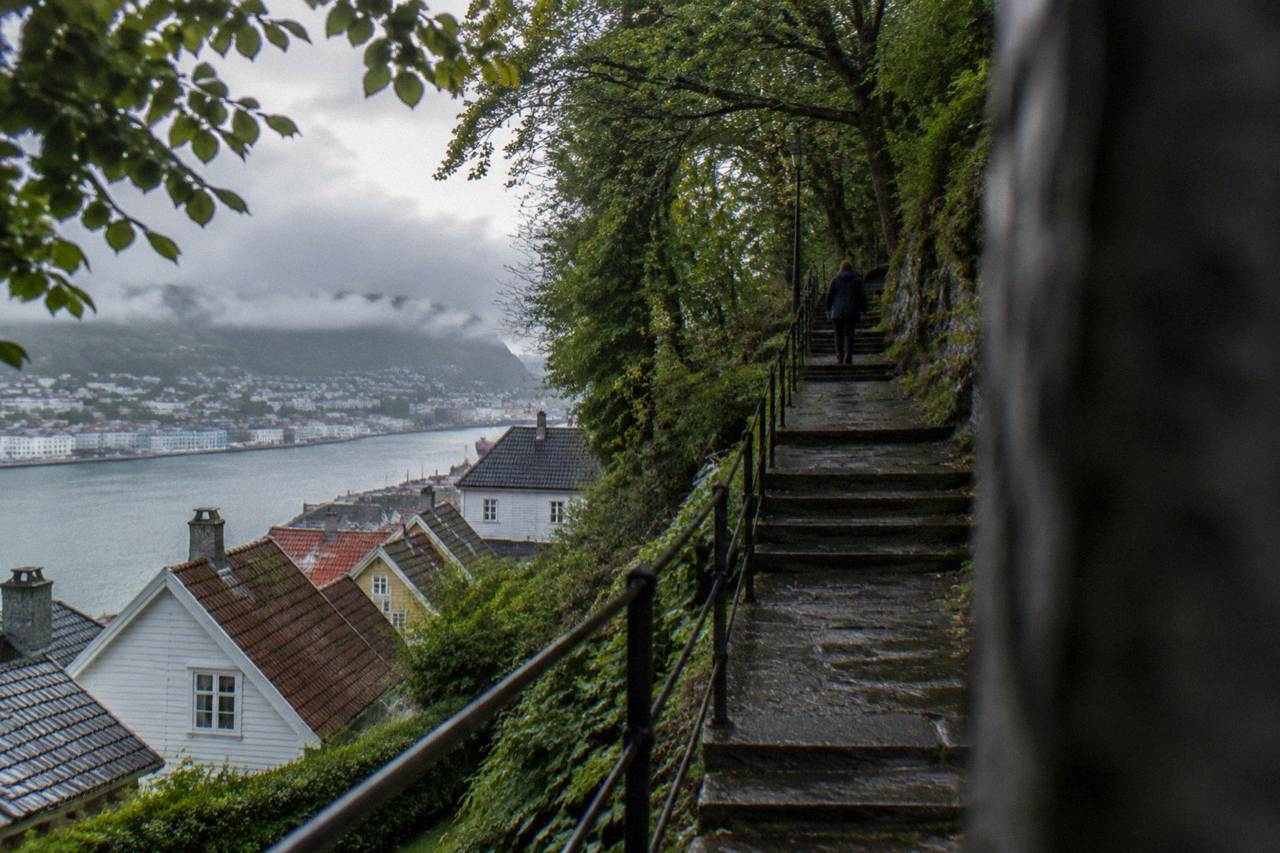
Stoltzekleiven is Bergen's most famous stair climb, a stone step path rising from the Fjellveien walkway on the city's northern flank toward the upland trails above Sandviken. Here is how to plan it, what it costs to reach, and how it compares with taking the Fløibanen funicular instead.
Short answer
Stoltzekleiven is a steep, stepped stone path in Bergen, Norway, climbing from the Fjellveien hillside walk toward the plateau above the city. It is free to use, popular with local runners, and demands steady legs rather than technical skill; the reward is a view over the harbour and the Sandviken wooden-house neighbourhood below.
Stoltzekleiven is the stone staircase that locals in Bergen, on Norway's southwestern coast in Vestland county, treat as both a workout and a rite of passage. It climbs the wooded hillside above the northern edge of the city centre, starting from the Fjellveien walkway and rising steeply toward the upland paths that link toward the Fløyen plateau. There is no ticket office, no queue for a machine, and no fee: the stair is a public path, and the only currency it accepts is effort. Bergen's climate is temperate oceanic and famously wet, with 217 days of precipitation recorded across the trailing thirteen months in the yr.no station table for the city, so the one thing every climber should pack is a layer against rain and a sole with grip.
What Is Stoltzekleiven In Bergen?
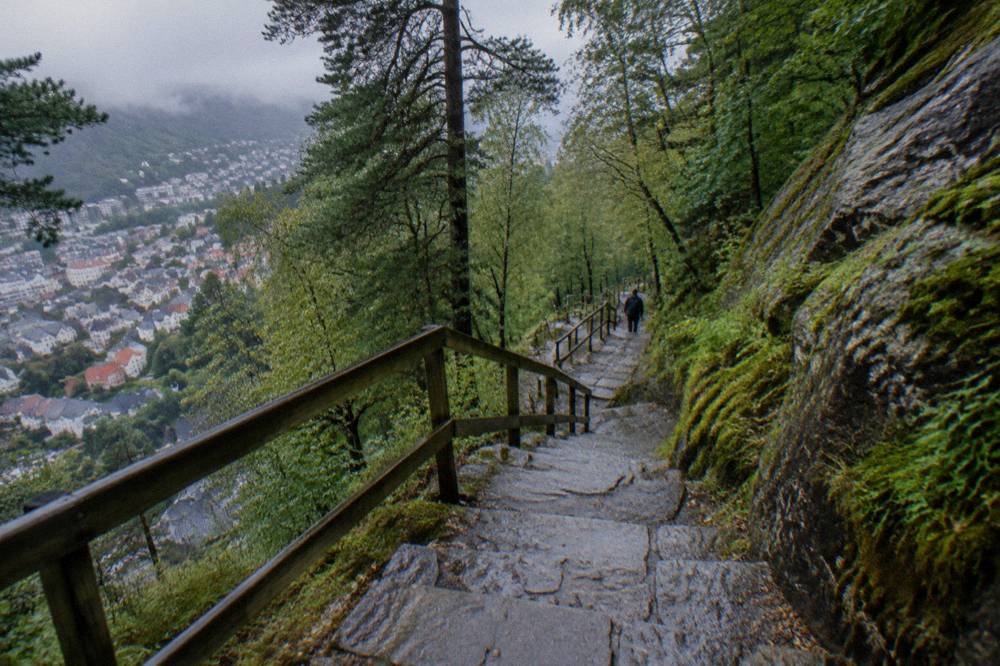
Stoltzekleiven is a stepped stone path in Bergen, Norway, cut into the steep hillside between the Fjellveien walkway and the higher ground above the Sandviken district, on the northern flank of the city's mountain wall. It is a public footpath with no entry charge, built as a fitness challenge, and it has become one of the most recognisable short hikes in the city, climbed daily by locals and visitors alike.
The stair belongs to a family of hillside paths that makes Bergen unusual among Norwegian cities. The centre sits on a narrow strip between the harbour and the mountains, and a network of walks threads up the slopes on that northern side. Fjellveien is the gentlest of these, contouring along the hillside above the wooden houses of Sandviken. Stoltzekleiven breaks away from that easy stroll and turns the experience vertical: stone after stone, roughly hewn, set at an angle that leaves no doubt about the intention. The name itself has entered local speech as shorthand for the climb, and someone can be found on it, from pensioners taking it slowly to runners using the steps for interval training.
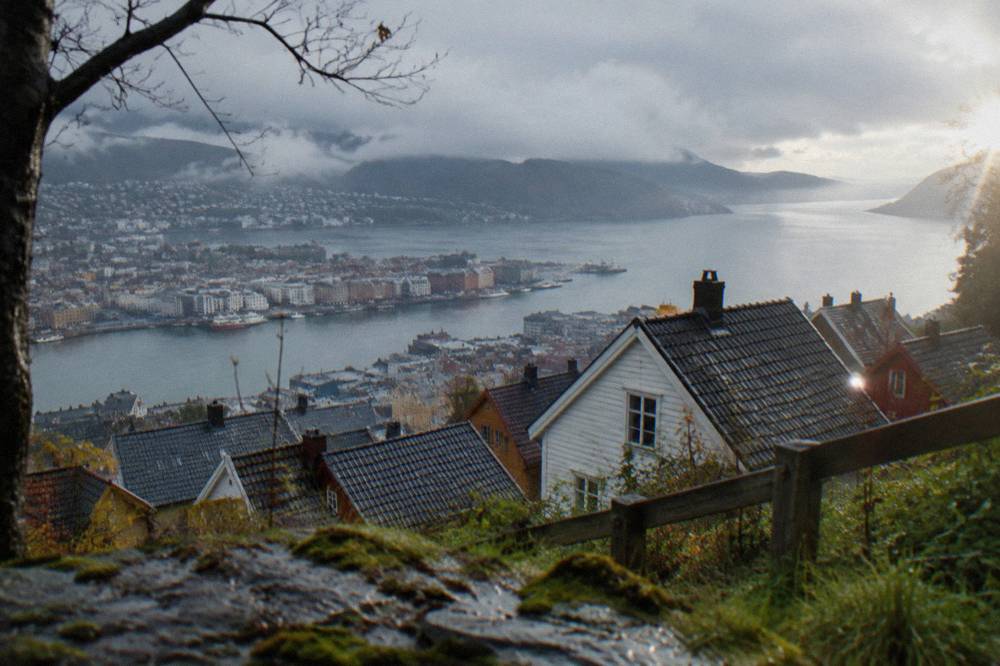
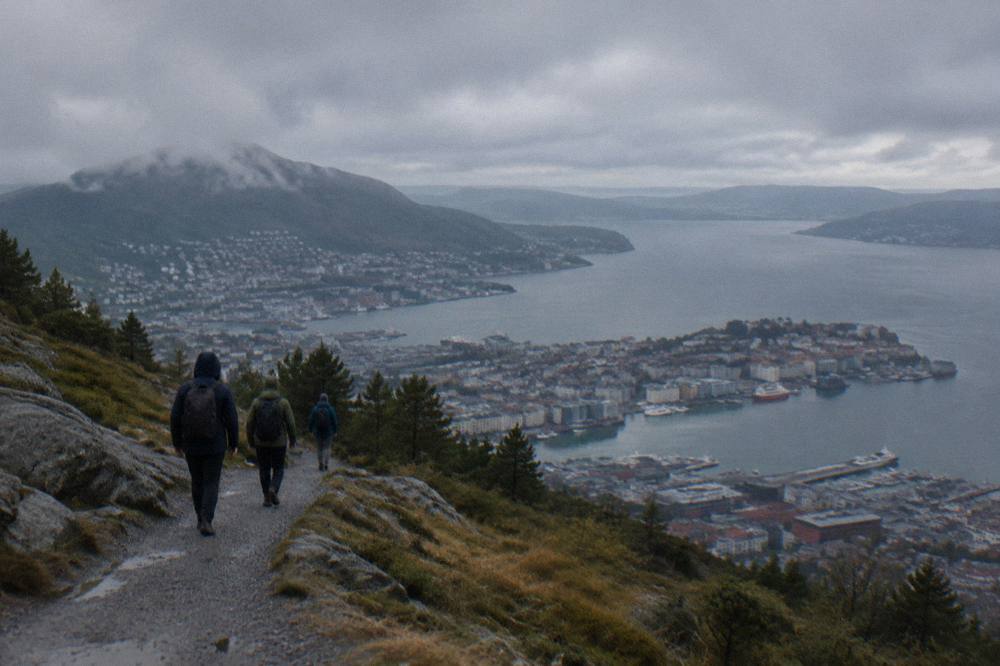
What the stair is not is a viewpoint with a fence and a kiosk. The upper section emerges onto the open ground above the trees, where the panorama opens over the harbour, the peninsula of Nordnes, and the water of Byfjorden beyond. The character of the place comes from that contrast: dark, damp woodland on the climb, and a broad city-and-sea outlook at the top.
How Hard Is The Stoltzekleiven Climb Really?
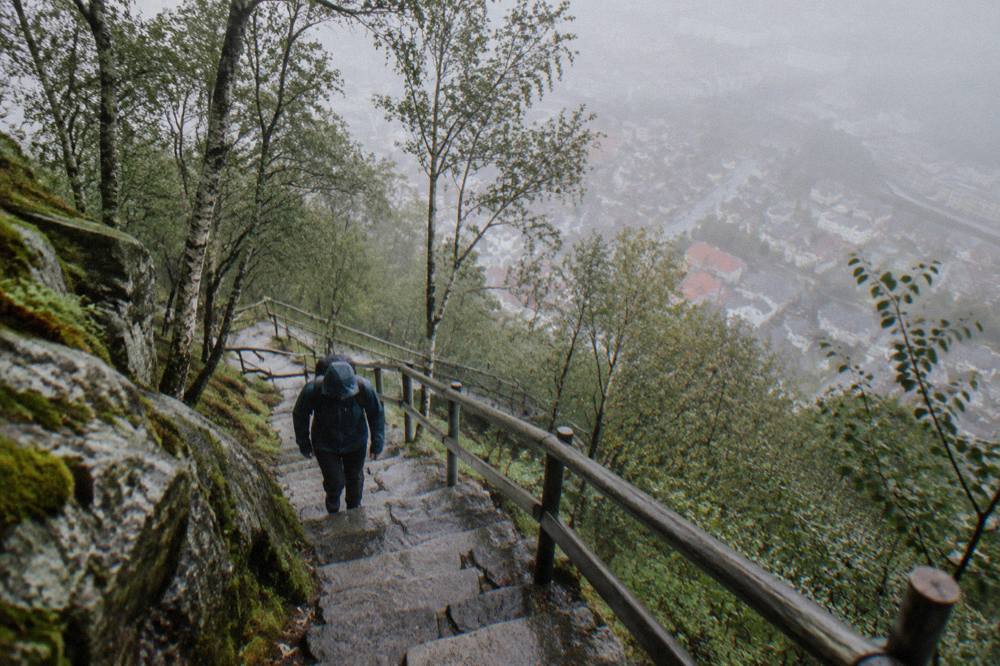
Stoltzekleiven is a short but genuinely steep climb, demanding steady legs, decent shoes and a willingness to keep going up steps without a break in gradient. It requires no scrambling, no equipment and no navigation skill, and it is within reach of any reasonably fit walker who paces themselves. The hardest part is the unrelenting angle of the stone steps, not distance or exposure.
Honesty is the best service here. The stair has a reputation among Bergen residents as a fitness test, and that reputation is earned. The steps are uneven in size and pitch, tree roots cross them in places, and after rain, which in this city is most of the time, the stone is slick. The climb is the kind of effort where the first stretch feels manageable, the middle stretch feels long, and the final stretch asks a small extra something. Anyone who manages a multi-storey staircase without stopping can complete it, but the pace will be slower than a normal walk.
The rewards come in two stages. Midway, small openings in the trees look out over the packed wooden houses of Sandviken, one of the oldest and most photographed residential districts in the city, which is covered in its own guide to the Sandviken neighbourhood. At the top, the stair joins the network of upland paths, and from there the terrain eases. The summit ridge and the higher plateau beyond are the domain of gentler walking, and links toward the wider hiking routes around the city are collected in the site's overview of hiking in Bergen.
For visitors who want the city's story told on flat ground before or instead, a guided walk is a different way to spend the same morning.
A city walk and a stair climb sit well together in one day: the first for orientation, the second for perspective. Many visitors do the stair early, while the air is cool and the stones are less busy, then spend the afternoon in the museums along the harbour.
How Do You Get To The Stoltzekleiven Trailhead?
The Stoltzekleiven trailhead sits on the Fjellveien hillside walk in Bergen, Norway, reached on foot from the city centre in the Sandviken direction, or by Skyss bus along the coastal road below it. A single adult Skyss ticket in zone A costs 51 NOK per the visitbergen.com transport page, and walkers who simply set out on foot from Torgallmenningen pay nothing at all.
The approach most locals use is the simplest one: walk north out of the centre, through the streets behind Torgallmenningen, toward the wooden houses of Sandviken, and join Fjellveien where the hillside walk begins. From there the stair is signposted. The walk to the start is itself part of the experience, because Fjellveien passes above some of the oldest surviving wooden buildings in the city, and the view opens long before any steps are climbed.
For anyone staying further out, or unwilling to add the approach on foot, the options are straightforward and cheap by Norwegian standards.
| Approach | What it is | Cost (from verified sources) | Notes |
|---|---|---|---|
| On foot from the city centre | Walking route through Sandviken to Fjellveien | Free | The approach most locals use |
| Skyss bus or Bybanen light rail | Public transport in zone A | 51 NOK single adult (visitbergen.com) | Route details in the Skyss travel planner |
| Bergen Card 24h | Card with free Skyss buses and Bybanen | 400 NOK adult, 100 NOK child (official 2026 flyer) | Also covers museums and discounted funicular |
| Taxi | On demand, hailed by phone or app in Bergen | Metered; no flat rate was sourced | Call-ahead booking is the norm, see the guide to calling a taxi in Bergen |
One practical note worth planning around: the Bergen Card's own 2026 flyer lists free Skyss buses and Bybanen light rail across Vestland county, including the airport line, so a cardholder can ride to the Sandviken side without paying per trip. The funicular up Fløyen, described below, is a discounted purchase at the ticket office with the card rather than free.
Once the morning climb is done, the question is how to spend the rest of the day, and for many visitors the answer is water: the fjords begin at the harbour a short walk downhill from the stair.
Each of these departs from the harbour side of the city, so the logistics work in a single day: stairs at dawn, lunch near the fish market, boat in the afternoon.
Stoltzekleiven Or Fløibanen: Which Way Up The Hill?
Stoltzekleiven and the Fløibanen funicular serve the same hillside in opposite styles: the stair is a free, strenuous, roughly half-hour-scale climb on foot, while Fløibanen is a paid cable railway that lifts passengers to the upper station with no effort at all. A return funicular ticket costs 200 NOK for an adult from 1 April to 30 September, and 145 NOK from 1 October to 31 March, per the official Bergen Card price table.
The choice is less about cost than about what the day is for. A climber who takes the stair earns the view, arrives warm, and knows the hillside intimately on the way down, because descending Fjellveien back toward town is gentle and scenic. A visitor who takes the funicular gets the same panorama in minutes, stays dry-shod, and conserves energy for everything else Bergen demands of a visitor's feet. Families with small children, and anyone with knee or hip trouble, will find the funicular the kinder option; the stair rewards a lone traveller who wants the city's best free workout.
| Option | Effort | Cost | Best for |
|---|---|---|---|
| Stoltzekleiven stair | High, continuous steps | Free | Fitness, solitude among trees, earned views |
| Fløibanen funicular return | None | 200 NOK adult Apr-Sep; 145 NOK Oct-Mar (Bergen Card flyer) | Families, time-saving, bad weather |
| Ulriken643 cable car return | None | 435 NOK adult (ulriken643.no) | The city's highest mountain instead |
| Fjellveien walk only | Easy | Free | A hillside stroll without the stair |
There is also a middle path that many regulars take: climb Stoltzekleiven up, then walk the plateau paths across and descend on foot, or descend via the funicular path and ride the railway down. Doing the stair in the up direction only is the correct order in wet weather, since the stones are safer climbed than descended in rain. The full case for the railway, including the winter ticket season, is laid out in the guide to Fløibanen and Mount Fløyen, and the rival mountain across the city has its own page at Mount Ulriken.
Pairing the morning climb with an afternoon on the water is the classic Bergen combination, and the Sognefjord route to Flåm is the longest single-day version of it.
The cruise departs from the harbour, below the hillside you have just climbed, and the operator's live listing carries the current fare and timetable.
What Is The Weather Like On The Stair, Month By Month?
Bergen's climate is temperate oceanic and wet in every season, and the yr.no station table for the city shows monthly mean temperatures ranging from -1.4C in January to 14.9C in July over the trailing thirteen observed months, with November the wettest at 321.8mm of precipitation against a 275.0mm normal. No month on the table is dry, so the stair is climbed in rain as a matter of routine, not exception.
The table below is the reason local advice about this climb always comes back to footwear. The stones are laid into the hillside and hold water; grip matters more than waterproofs.
| Month | Mean temp (observed) | Precipitation (observed mm) | Precip normal (mm) |
|---|---|---|---|
| September | 13.1 | 206.6 | 248.0 |
| October | 9.7 | 231.9 | 268.0 |
| November | 6.0 | 321.8 | 275.0 |
| December | 5.8 | 303.5 | 290.0 |
| January | -1.4 | 82.0 | 256.0 |
| February | 0.8 | 133.4 | 209.0 |
| March | 5.9 | 243.9 | 202.0 |
| April | 7.9 | 65.9 | 141.0 |
| May | 9.9 | 127.4 | 109.0 |
| June | 14.4 | 165.7 | 132.0 |
| July | 14.9 | 184.2 | 158.0 |
| August | 14.3 | 243.6 | 208.0 |
Reading the table honestly changes plans for the better. April and January stand out as the driest months in the observed period, and April pairs that with a mean of 7.9C, which makes it a quietly excellent month for the stair. November is the month to climb only with full rain kit and lower expectations of the view, since cloud often sits on the hillside. Summer months are mild rather than hot, and the shade of the stair's trees keeps the climb cooler than the open plateau above. The site's seasonal pages, including the guide to Bergen weather and the month-by-month breakdown of the best time to visit Bergen, treat these figures in more depth.
What Should You Wear And Carry For The Climb?
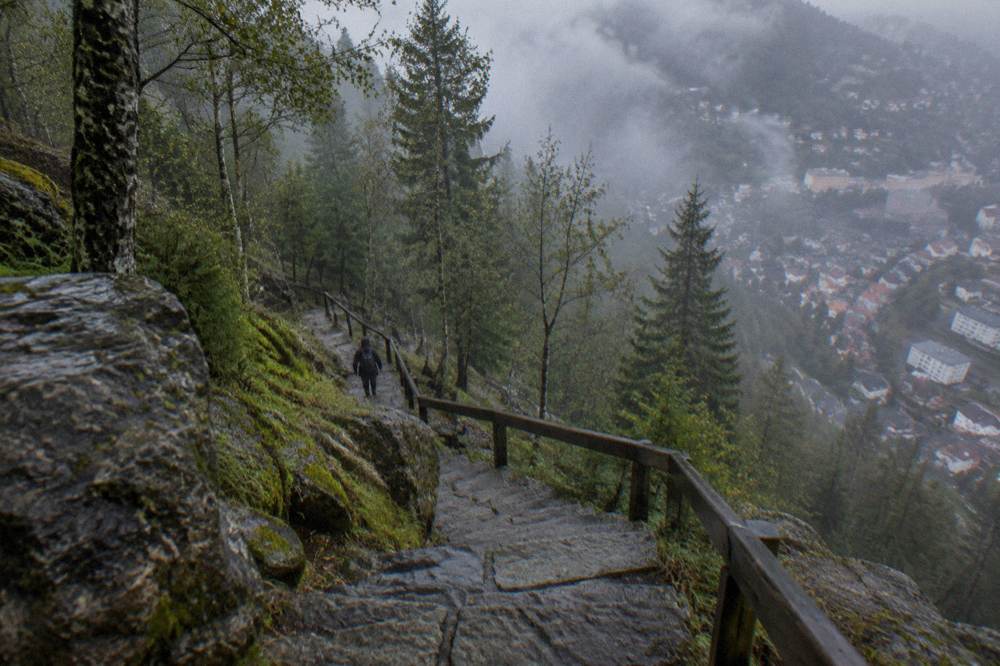
Stoltzekleiven calls for shoes with real tread, a rain layer in every season, and water, plus a hat and gloves outside the summer half of the year. The stones are uneven and slick in the rain that falls on 217 of the trailing thirteen months' days, and the shaded stair stays cooler than the city streets below. Nothing technical is needed: this is a path, not a route.
The packing question is mostly a footwear question. Trail shoes or worn-in trainers with a soft, grippy sole are ideal; smooth-soled leather shoes, whatever their price, are wrong for wet stone. A light waterproof jacket does double duty against rain and wind on the exposed upper section. In winter the path can hold ice, and local practice is to treat any icy morning with either shoe spikes or a decision to come back another day. A small backpack is enough: water, a snack, the jacket, and a phone. There is nothing to buy at either end of the stair, so carrying is the only option.
One clothing question that reaches beyond the hillside is what counts as normal dress for a Norwegian city visit generally, and the answer, surprisingly often, includes the jeans this site's packing guide gets asked about most. The fuller discussion lives in what to pack for Bergen, including the layering logic that locals actually use.
What Do You Do At The Top Of Stoltzekleiven?
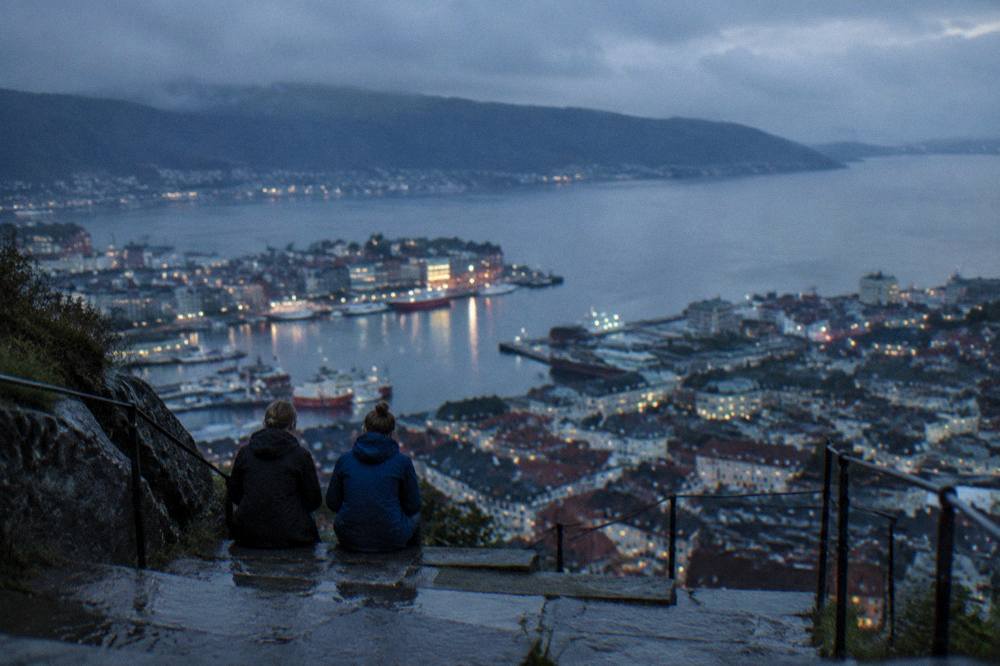
The top of Stoltzekleiven is not a single summit but a junction: the stair delivers climbers onto the open upland paths above Bergen, from where the network runs along the ridge, toward the Fløyen plateau and its funicular station, and down toward the northern suburbs. The immediate reward is the view over the harbour, Byfjorden and the wooden houses of Sandviken, best in clear morning light.
Most walkers take a few minutes at the top, then choose one of three continuations. The first is to loop: walk the upland path across toward the funicular side of the hill and descend through the plateau's easier trails, ending the day with a downhill stroll into the centre. The second is to extend upward and outward along the ridge paths, which is where the stair becomes a gateway into proper hillside walking rather than a single effort. The third is simply to go back down the way you came, which in dry conditions is perfectly reasonable, and in wet conditions is the one part of the day that deserves the most care.
The upland network is described in full in the hiking overview, but the essential point for a first-time visitor is that the top of the stair is a crossroads, not a dead end. The funicular station is a landmark worth aiming for on a first visit, because it anchors the plateau and makes the geography legible, and because the ride down, at the seasonal prices listed above, is a fair trade for tired legs.
What Sits Near The Stair For The Rest Of The Day?
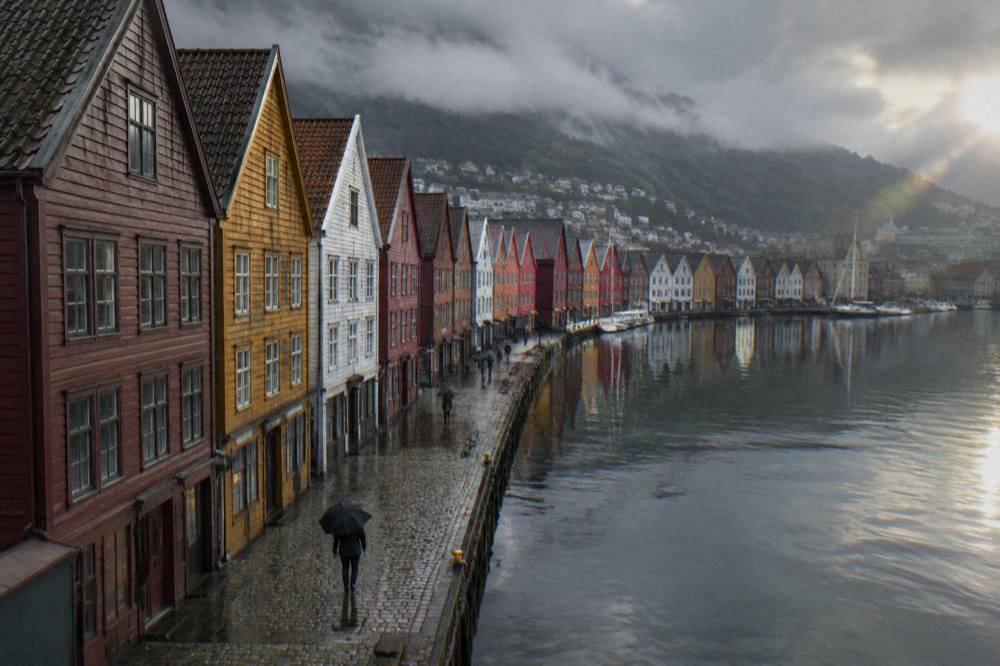
The Stoltzekleiven trailhead sits on the northern hillside of Bergen, Norway, a short walk above Sandviken, which puts the city's oldest wooden-house district, the harbour-side UNESCO wharf at Bryggen, and the museums of the peninsula within an easy walking circuit of the stair. Climb early, then spend the afternoon on flat ground; the geography rewards that order.
Descending from the hillside toward the water, the day unfolds downhill. The Sandviken streets below the stair are among the most photographed in the city, white wooden houses stacked on the slope, and they lead naturally toward the harbour. From there the Bryggen wharf, inscribed on the World Heritage List in 1979 by UNESCO's own listing, is the anchor sight, with the Bergen Fish Market beside it. The peninsula beyond holds a cluster of the museums covered by the Bergen Card, priced in the official 2026 flyer.
| Nearby sight | Ordinary price (official 2026 Bergen Card flyer) | With Bergen Card |
|---|---|---|
| Bryggen Museum | 170 NOK | 85 NOK |
| Hanseatic Museum | 160 NOK (incl. guided visit) | Discounted |
| Haakon's Hall | 120 NOK | Included |
| KODE Art Museums | 200 NOK listed on the flyer | Included Oct-Apr; 25% discount May-Sep |
| The Aquarium (Akvariet) | 380 NOK Nov-Feb; 380/415 NOK Mar-Oct | Discounted |
The card itself comes in four durations, and the flyer's prices are worth a small table of their own, because the arithmetic changes with the pace of the itinerary.
| Bergen Card | Adult | Child (3-15) |
|---|---|---|
| 24 hours | 400 NOK | 100 NOK |
| 48 hours | 500 NOK | 125 NOK |
| 72 hours | 600 NOK | 150 NOK |
| 96 hours | 700 NOK | 175 NOK |
A climber who has spent a morning on the stair and an afternoon in museums will clear the value of the 24-hour card quickly, given transport is included. The full decision logic, including the funicular discount, is in the guide to the Bergen Card, and the wider question of costs is handled in how expensive Bergen is.
For visitors turning the climb into a full fjord day, or a second day beyond it, the self-guided round trip is the most flexible option, since it leaves the pacing entirely to you.
It pairs naturally with the stair on a two-day plan: day one for the city and the hillside, day two for the fjord, with the cruise and mountain railway stitched together on your own schedule.
Is Stoltzekleiven Safe, And Who Should Skip It?
Stoltzekleiven is a safe public path for anyone with ordinary fitness and sound shoes, with no exposure, no scrambling and no navigation difficulty, and its main hazards are slick stone in rain and ice in winter. Visitors with knee, hip or heart conditions should consider the funicular instead, and descending in heavy rain deserves more care than climbing it.
The honest risk profile is short. The stair is wide enough for two people in most places, it sits within the city, and other climbers pass at all hours of daylight, so help is never far away. What catches people out is not danger but dignity: wet stone, a hurried descent, and a phone in one hand. The site's wider treatment of urban safety in the city, including the practicalities of solo and evening wandering, is in the guide to whether Bergen is safe, and the general verdict there applies to the stair doubled: the most likely mishap is a slip, and the best prevention is footwear and unhurried feet.
Children manage the stair happily in either direction, and many families treat it as a challenge the kids win outright. Dogs are a common sight on the hillside paths, as they are across the city's walking routes. The one group the stair genuinely does not suit is anyone told by a doctor to avoid sustained steep effort, and for them the funicular at the seasonal prices above delivers the same view without the cost to the knees.
Common Questions About Stoltzekleiven
How hard is Stoltzekleiven?
It is a steep, continuous stone stair climb with no technical difficulty: no scrambling, no exposure, no route-finding. Any reasonably fit walker can finish it at a slow pace, but the unbroken gradient makes it a genuine effort rather than a stroll. Shoes with grip matter more than fitness on wet days.
Is Stoltzekleiven free?
Yes, the stair is a free public path on Bergen's northern hillside, reached on foot from the city centre at no cost. Only transport to the trailhead or the optional funicular descent carries a fare: a zone A Skyss ticket is 51 NOK, and a Fløibanen return is 200 NOK adult in the April to September season per the official 2026 Bergen Card flyer.
Can you combine Stoltzekleiven with Fløibanen?
Yes, and it is a classic local circuit: climb the stair, walk the upland paths across toward the plateau, and descend on the funicular or its walking path. The funicular's own station sits on the same hillside, and the connection is the reason many walkers do the stair one-way upward.
When is the best time of day to climb Stoltzekleiven?
Early morning, for three reasons: the stones are less busy, the light is best over the harbour and Sandviken, and the day's rain, which in this city falls on 217 of the trailing thirteen months' days by the yr.no station table, tends to arrive later. Winter mornings deserve an ice check before committing.
Is Stoltzekleiven suitable for children?
Fit children climb it readily and often faster than their parents, and the path has no hazard beyond wet stone. Keep them unhurried on the descent, which is the likelier place for a slip, and bring the funicular option as a bail-out if legs run out at the top.
How does Stoltzekleiven compare with Mount Ulriken?
They are different experiences: Stoltzekleiven is a free stair climb on the city's northern hillside, while Ulriken, the higher mountain across town, is served by the Ulriken643 cable car at 435 NOK for an adult return per ulriken643.no's own prices page. The stair earns its view on foot; the cable carlifts you to the biggest one in comfort.
For a final look at how the day can be stretched beyond the stair itself, these three departures from the harbour cover the classic ways to turn a hillside morning into a full fjord itinerary.
The stair is the most Bergen of the city's small adventures: free, wet, steep, and generous with its view. For the full planning picture around it, from the airport in to the fjords out, start with Bergen Travel Guide and its overview of the city, then work outward through the hillside, harbour and fjord pages this climb connects.