Fløibanen Funicular In Bergen Norway
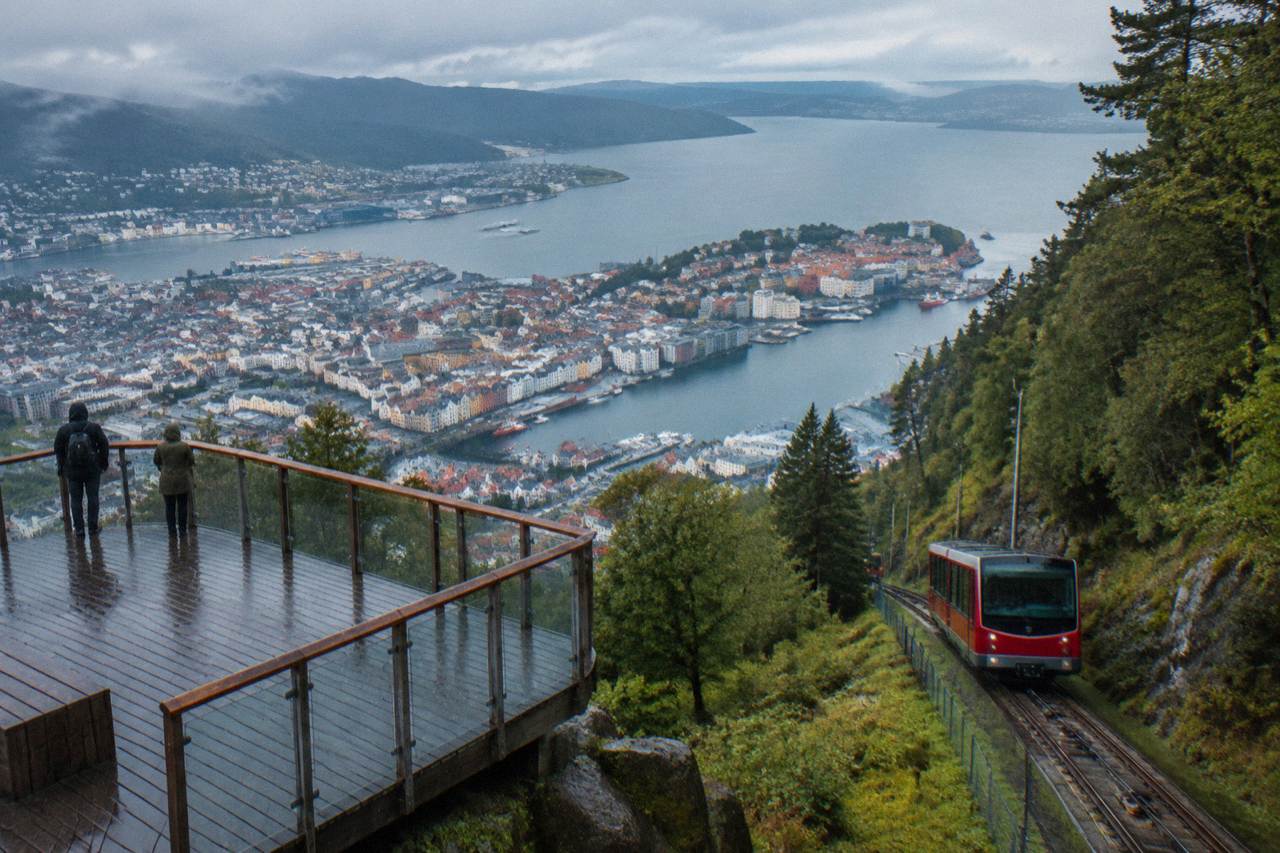
The Fløibanen funicular climbs from the heart of Bergen, Norway, to Mount Fløyen above the city, and this page covers the current ticket prices, the Bergen Card discount, and what awaits at the top.
Short answer
A Fløibanen return ticket costs 200 NOK for an adult and 100 NOK for a child aged 3-15 from 1 April to 30 September, and 145 NOK adult / 75 NOK child from 1 October to 31 March, per the official Bergen Card price table for 2026. Bergen Card holders get a discounted rate, one ride per card, bought at the ticket office.
Bergen, on the southwestern coast of Norway in Vestland county, keeps its best panorama locked a few hundred vertical metres above the red warehouses of Bryggen, and the Fløibanen funicular is the key that city still uses to reach it, the original cars having hauled their first passengers up the Fløyen slope long before the cruise terminal was ever drawn. The ride starts a short walk from the fish market, in a station that sits inside the city rather than at its edge, which is precisely why nearly every visitor ends up on it. Two cars on a single cable take turns passing each other at the midpoint, the floor tilting as the gradient bites, and then the forest opens and Bergen lies below, a former Hanseatic League trading post of roughly 294,860 people spread across the peninsula and the hillsides that ring the harbour. This page covers the current prices, what the Bergen Card actually buys you here, how the mountain compares with Ulriken across the valley, and what to do once the doors open at the top.
What Is The Floyen Funicular In Bergen Norway?
The Fløibanen funicular is a cable-hauled railway connecting central Bergen to Mount Fløyen, with its lower station a short walk from the fish market and its cars meeting at a passing loop halfway up the forested slope. It is not a cable car and not a chairlift: two counterbalanced cars run on rails, pulled by a station-drum cable, and the system has been carrying residents and visitors up the mountain for generations. Locals use it the way other cities use a steep bus route, commuting through the woods to trailheads, playgrounds and viewpoints, which explains why the queue at the bottom is a genuine mixed crowd of schoolchildren and camera-laden travellers. The upper station empties onto a terrace where the whole of Bergen, its peninsula, its harbour islands and the fjord arms beyond are laid out at once.
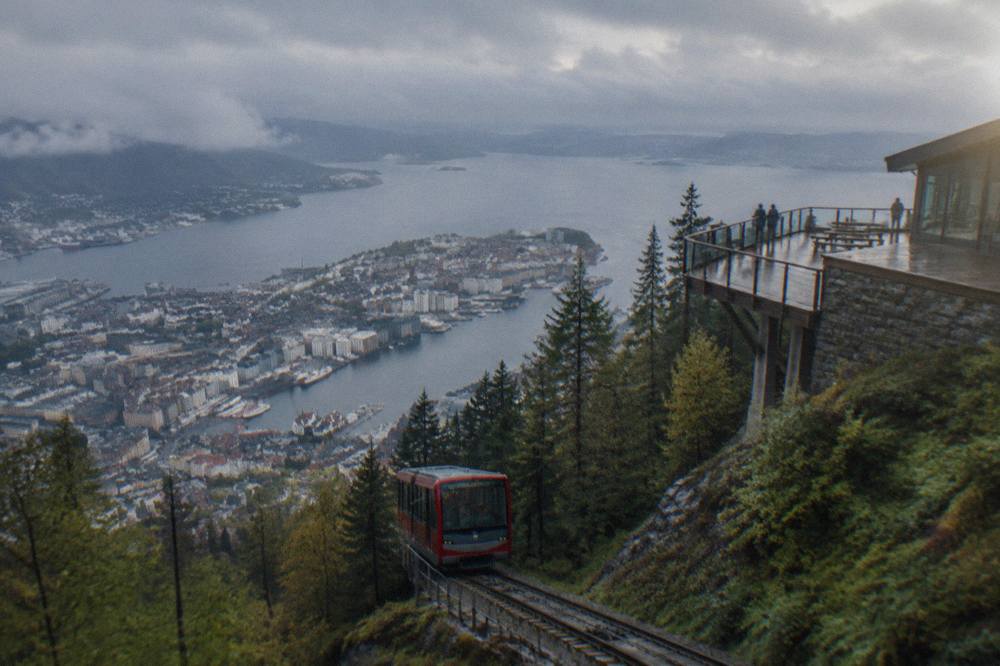
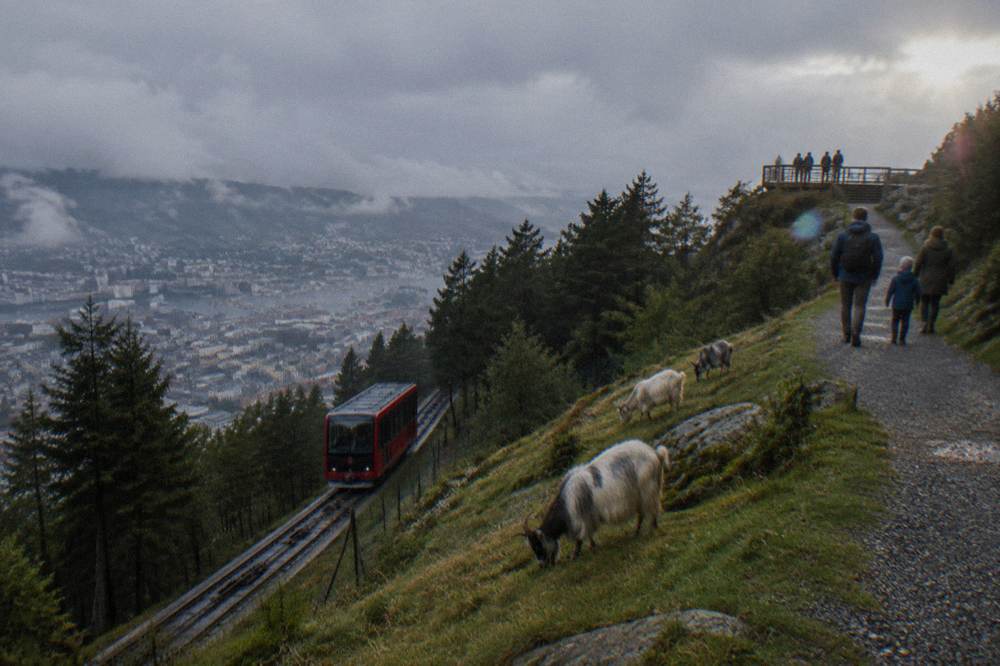
The mountain the railway serves, Fløyen, is one of the seven peaks that surround the city, and its summit plateau is less a summit than a park. Gravel trails run out from the upper station in every direction, one dropping gently toward the Skostredet and Marken streets below, another contouring around toward the Troll forest with its carved wooden figures, a third climbing onward toward higher ridges. Goat and sheep graze near the top station in summer, there is a playground a short stroll along the plateau, and the shop and cafe by the exit sell the usual cinnamon-scented consolation for the queue you may have waited in below. What the ride buys, more than anything, is time: the walk up on foot is a genuine hike, the ride up is not.
For planning purposes, the funicular pairs naturally with the rest of the city centre. Bryggen, the Hanseatic wharf, is a UNESCO World Heritage site, inscribed in 1979 according to UNESCO's own listing, and its lower station sits barely a few streets from it. Visitors combining the ride with a museum morning can walk from the KODE art museums or the Bergen fish market without needing a bus at all. This matters because the single biggest mistake people make with Fløibanen is treating it as a half-day excursion, when the mountain works best as a short frame around the rest of a city-centre day.
How Much Does The Bergen Funicular Cost?
A Fløibanen return ticket costs 200 NOK for an adult and 100 NOK for a child aged 3-15 in the summer window from 1 April to 30 September, and 145 NOK for an adult and 75 NOK for a child from 1 October to 31 March, according to the official Bergen Card price table published by visitbergen.com. Those are ordinary walk-up prices for the return journey, the form almost everyone should buy, since the view down from the terrace is half the point of the view up. The same flyer lists a discounted Bergen Card rate as well, and that rate is purchased at the ticket office rather than through any app, one discounted ticket per card. Note that the winter price applies across the shoulder season too: a mild, wet October day in Bergen costs the same as a snowy January one.
| Ticket | Dates | Adult (NOK) | Child 3-15 (NOK) |
|---|---|---|---|
| Fløibanen return, summer | 1 Apr - 30 Sep | 200 | 100 |
| Fløibanen return, winter | 1 Oct - 31 Mar | 145 | 75 |
| Bergen Card 24h | year-round | 400 | 100 |
| Bergen Card 48h | year-round | 500 | 125 |
| Bergen Card 72h | year-round | 600 | 150 |
| Bergen Card 96h | year-round | 700 | 175 |
The comparison row with the Bergen Card is deliberate, because the arithmetic is where most guidebooks stop explaining. A 24-hour card at 400 NOK costs exactly double a summer return ticket, but the card also carries free Skyss buses and the Bybanen light rail across all of Vestland county, including the airport line, plus discounted or included entry at museums and attractions across the city. Anyone planning to ride the funicular and visit even two paid attractions is already close to break-even. The dedicated page on whether the funicular is worth its price walks through the scenarios in more detail, including the walking alternative.
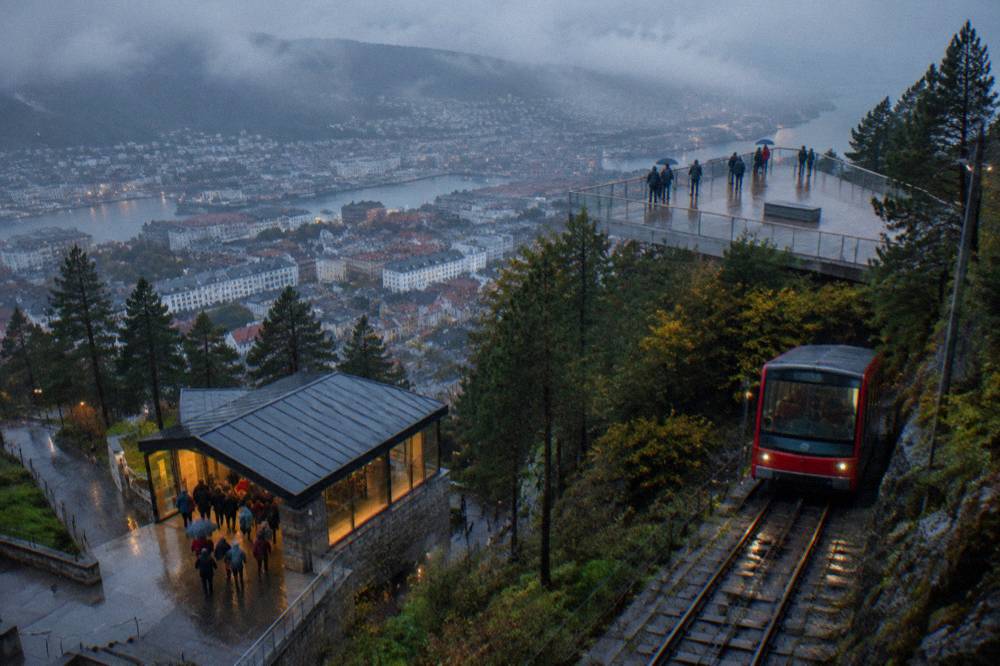
Two practical notes on buying. First, the discounted Bergen Card rate is sold at the ticket office only, so card holders should not queue at the machines expecting the discount to apply automatically. Second, the climate of Bergen is temperate oceanic and wet: yr.no's Bergen station table, drawing on Met Norway data, counted 217 days with precipitation across the trailing thirteen months, with monthly rainfall ranging from 65.9 mm in an unusually dry April to 321.8 mm in November. The funicular runs in all of it, and the terrace view changes character entirely with the weather, from sharp blue fjord panoramas to cloud interiors with the city reduced to rooftops below the mist line.
What Does The Bergen Card Include On Floyen?
The Bergen Card includes a discounted Fløibanen return ticket, one per card, purchased at the ticket office rather than at a machine, on top of the card's free transport coverage across Skyss buses and the Bybanen light rail throughout Vestland county, including the airport line. That is the shape of the deal: the funicular is not free with the card, it is discounted, and the discount price lives on the flyer's ordinary-price table alongside the season windows. The card's transport coverage, by contrast, is full and unconditional, which matters for anyone arriving at Flesland airport, since the Bybanen airport line counts as ordinary Skyss travel and a single zone A ticket bought without a card costs 51 NOK per the visitbergen.com travel page.
| Bergen Card duration | Adult (NOK) | Child 3-15 (NOK) | Fløyen benefit | Transport benefit |
|---|---|---|---|---|
| 24 hours | 400 | 100 | discounted return, once per card | free Skyss + Bybanen, incl. airport line |
| 48 hours | 500 | 125 | discounted return, once per card | free Skyss + Bybanen, incl. airport line |
| 72 hours | 600 | 150 | discounted return, once per card | free Skyss + Bybanen, incl. airport line |
| 96 hours | 700 | 175 | discounted return, once per card | free Skyss + Bybanen, incl. airport line |
The card also pulls its weight off the mountain. The same Bergen Card flyer lists the Bergen Aquarium at 380 NOK in the winter window and 380 to 415 NOK seasonally in summer, Haakon's Hall inside the Bergenhus fortress at 120 NOK, the Hanseatic Museum at 160 NOK including a guided visit, and the Bryggen Museum at 170 NOK ordinary or 85 NOK with the card. KODE's art museums appear on the flyer at 200 NOK in the free-admission window from 1 October to 30 April and in the 25 percent discounted summer window, a figure the flyer treats as the card price rather than KODE's own standalone adult price, which the ticket page does not list. Anyone stacking the funicular with the fortress and one museum crosses the 400 NOK card threshold on the first afternoon.
The practical rhythm for a card holder is simple: validate nothing, show the card at the Fløibanen ticket office window, keep the card in a pocket for the museum queue at the bottom, and let the free buses cover anything beyond walking range. One caution belongs here: the discount applies once per card, so a family shares no pool, each member's card carries its own single discounted return. Solo travellers and couples gain the most from the transport side of the card, families with children gain the most from the museum discounts, since child card prices are low and child museum admission often is not.
Funicular Or Cable Car: Which Bergen Mountain View Is Better?
The Ulriken643 cable car costs 435 NOK for an adult return ticket per its own price pages, more than double Fløibanen's summer return at 200 NOK, but it serves the highest of Bergen's seven mountains while Fløyen serves the closest one, so the choice is between height and convenience rather than quality. Ulriken's summit is the taller viewpoint with longer sightlines, and its aerial cabins hang on a suspended cable rather than running on rails through the forest. Fløyen's station is inside the city, a few streets from the fish market; Ulriken's lower station is farther from the centre and generally reached by bus. The dedicated comparison of the cable car versus the funicular goes deeper, but the price gap alone decides it for many visitors on a short stay.
| Feature | Fløibanen funicular (Fløyen) | Ulriken643 cable car (Ulriken) |
|---|---|---|
| Adult return, summer (NOK) | 200 | 435 |
| Child return, summer | 100 | see the operator's own pricing page |
| Lower station location | central Bergen, walk from fish market | outside the centre, bus or taxi |
| Ride style | two rail cars, forest tunnel sections | aerial gondola cabins on a cable |
| Summit character | plateau park, trails, playground | highest of the seven city mountains |
| Bergen Card benefit | discounted return, once per card | listed as discounted in the flyer |
One operational note belongs in any current planning conversation: the Ulriken643 cable car has scheduled maintenance closures in the first weeks of 2026, reopening around 13 January, alongside standard Christmas closures, per the operator's own site. No comparable closure was announced for Fløibanen, Bryggen, KODE, the fish market or the other headline attractions. Anyone visiting in the first half of January should check both operators before building an itinerary around either mountain. The full index of guides sits on Bergen Travel Guide.
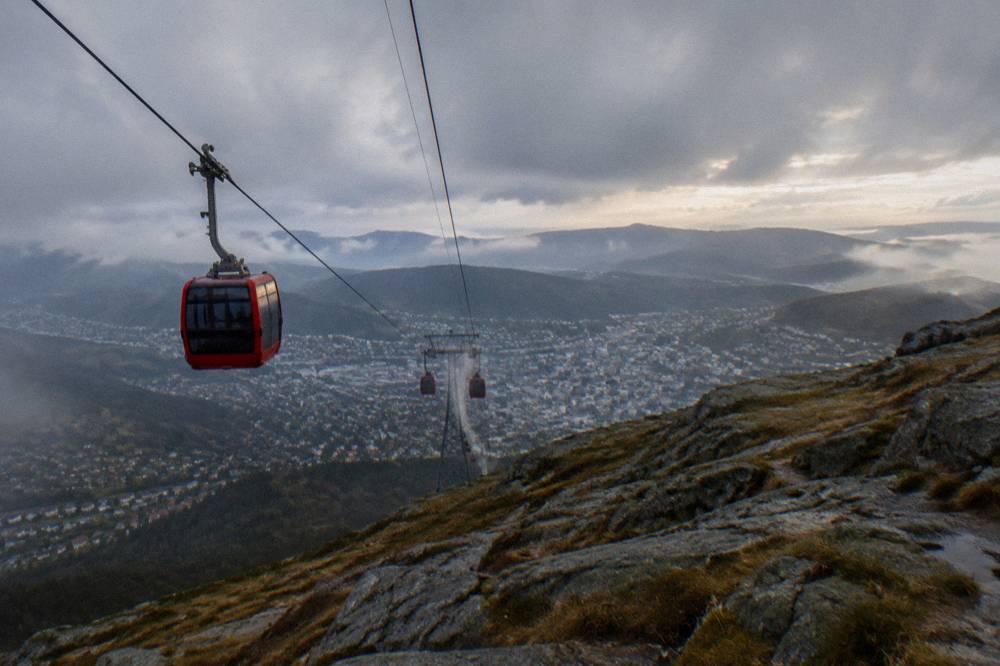
The honest answer for most first-time visitors is Fløyen first, Ulriken if the stay runs long. The funicular is the one you will actually do, because it sits inside the walking day you were already having. The cable car is the one you will plan for and possibly miss. For a longer itinerary, Mount Ulriken has its own page on this site, and the two mountains are linked by a ridge trail that turns them into a single hike for anyone with the weather and the legs for it.
What Is At The Top Of Floyen In Bergen?
The top of Fløyen is a forested plateau park with a viewing terrace over the city, a cafe and shop by the station, a playground, grazing goats in summer, and a network of gravel and forest trails, including the carved wooden trolls of the hillside path and the trail network beyond the stone steps on the city side. None of it is ticketed: the terrace, the trails, the troll forest and the animals are all open to anyone who has ridden up, walked up or arrived on skis in winter. The plateau flattens where the summit ridge would pinch, which is what makes it work for families, and the forest edge gives the terrace a framed, almost theatrical view down over the harbour.
| Attraction at the top | Type | Cost | Notes |
|---|---|---|---|
| Upper-station viewing terrace | viewpoint | 0 NOK | panorama over city, harbour islands, fjord arms |
| Troll forest path | walk with carved figures | 0 NOK | wooden trolls along the trail below the station |
| Plateau playground | family | 0 NOK | short walk from the upper station |
| Goats and sheep, summer | animals | 0 NOK | graze near the station in season |
| Trail toward higher ridges | hiking | 0 NOK | continues across the seven-mountain network |
| Cafe and shop by the station | food, souvenirs | pay as you order | weather-dependent hours |
The walk back down deserves its own sentence, because it is the plateau's best-kept secret. A marked trail descends from the upper station through the woods toward the city, emptying out near the Marken and Skostredet streets, and the descent takes in the Shaky Bridge, a small wooden suspension bridge on the lower section that children treat as the day's highlight. Walking down instead of riding down saves the return portion of a single-journey approach and turns the funicular into a loop: ride up, wander the plateau, walk down. Anyone who wants the reverse, hiking up first and riding down, should know that the stone-step climb is steep and popular with locals training on it; it has its own page on this site.
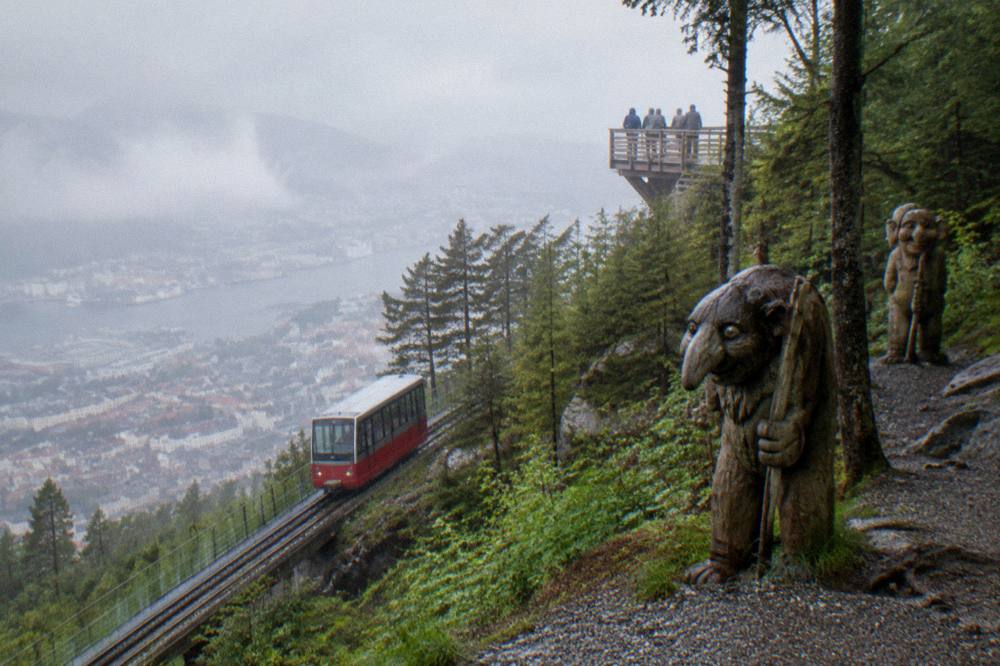
Weather changes the plateau completely, and Bergen's weather changes fast. Met Norway's data for the trailing thirteen months shows the city swings from a monthly average of -1.4°C in January to 14.9°C in July, with 217 days of precipitation in the period. On a clear summer evening the terrace is the warmest, brightest place in the city, the sun sitting late over the fjord. On a wet November day, when the station's own statistics table shows the wettest observed month at 321.8 mm of rain, the plateau becomes a cloud: the trees drip, the view ends fifty metres out, and the cafe becomes the destination. Both are real visits. Pack for the second and hope for the first.
For travellers who prefer the mountain with a guide, a food-and-culture option pairs the ride with the city's best bites: a taste of Bergen food tour with the Fløibanen funicular works the funicular into a walking-and-eating route, and the listing's own page carries the current price and availability. The free, tip-based walking tours on the GuruWalk platform are another way to have the city explained on the way to the station, with several Bergen guides running routes through the centre. Neither replaces the mountain, but both make the walk to the lower station part of the day rather than dead time.
When Is The Best Time To Ride The Bergen Funicular?
The best time to ride Fløibanen is a clear morning or late evening in the summer half of the year, roughly May through September, when the summer return price of 200 NOK adult applies and the terrace holds its light; the winter window from 1 October to 31 March drops the return to 145 NOK adult and 75 NOK child, trading light for price and crowd. Rain, not cold, is the real scheduling variable in Bergen: the city is temperate oceanic, and the yr.no station table records rain falling in every single month of the trailing thirteen, from 65.9 mm in April to 321.8 mm in November. Locals check the forecast and ride in the gaps.
| Month | Mean temp (°C) | Observed precipitation (mm) | Verdict for the terrace |
|---|---|---|---|
| March | 5.9 | 243.9 | changeable, often empty trails |
| April | 7.9 | 65.9 | driest observed month, spring light |
| June | 14.4 | 165.7 | long light, busiest queues |
| July | 14.9 | 184.2 | warmest average, peak season |
| September | 13.1 | 206.6 | soft light, thinner crowds |
| November | 6.0 | 321.8 | wettest observed, cloud-level views |
The early-morning ride is the quiet one, and the late-evening ride is the one residents defend hardest: in June and July the Norwegian summer light stretches well past the conventional evening, and the terrace at that hour belongs almost entirely to the people who thought to come back up after dinner. Festival weeks change the city below, too. The Bergen International Festival runs 26 May to 12 June in 2027 for its 75th jubilee edition per fib.no's own programme pages, Bergenfest follows on 9 to 12 June at Bergenhus fortress, and Nattjazz runs 28 May to 5 June, so a late-May or early-June visit puts the funicular ride inside the city's loudest, brightest fortnight.
A guided walk through the old and new city is the natural companion to a festival afternoon, since the same streets the guides cover sit between the festival venues and the funicular's lower station, and an evening ride up afterwards beats any bus back to a hotel. Travellers who book ahead for the festival fortnight tend to find both the guides and the funicular queue busier than usual, which is the one argument for visiting outside it.
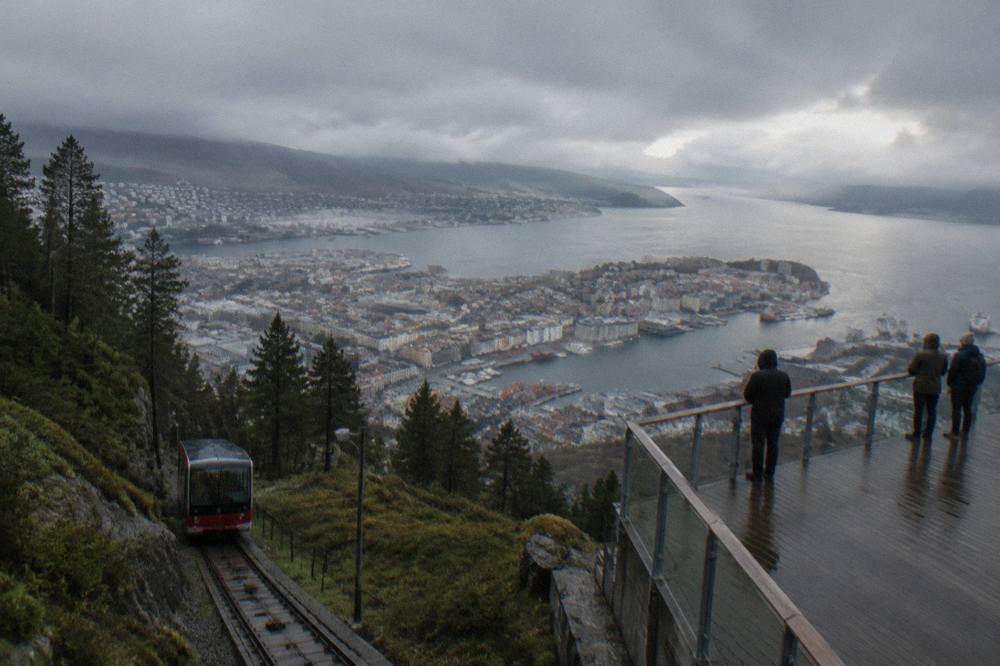
Winter deserves a fairer hearing than it gets. The winter ticket is the cheaper one at 145 NOK adult, the plateau occasionally holds snow when the city below is raining, and the forest path down under bare trees is its own kind of walk. The trade is light: no verified daylight-hours figure for Bergen's winter is quoted here, but any visitor who has stood on a Norwegian terrace in December knows the day is short and the queue is not. Those planning a full festive visit should look at the city's Christmas season, when the gingerbread city and the market at Festplassen run from mid-November into late December.
How Do You Get To The Fløibanen Station In Bergen?
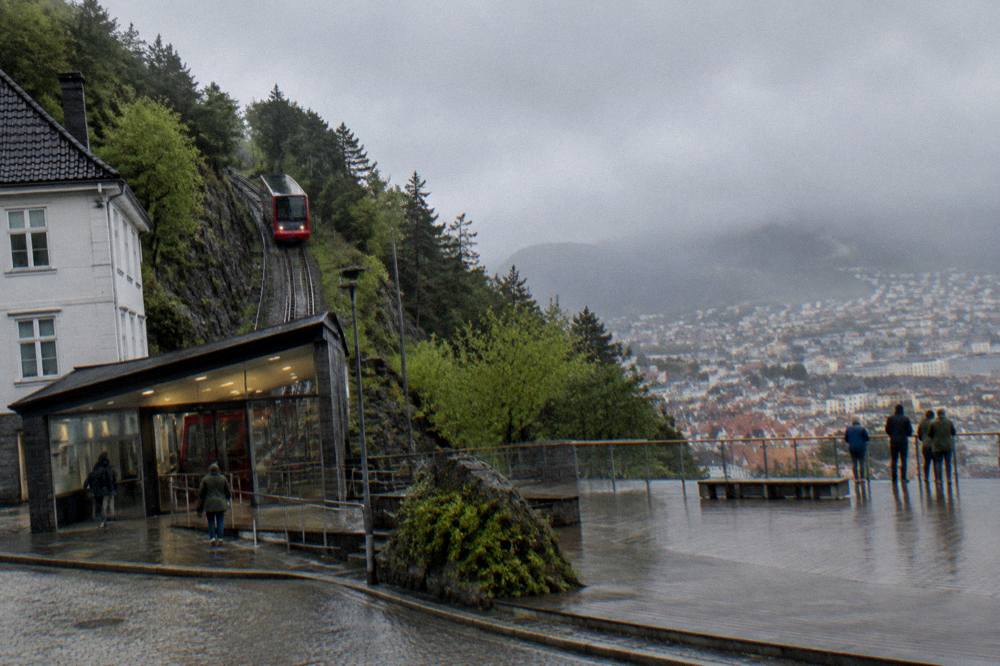
The Fløibanen lower station sits at the inner end of the city centre, reached on foot in a short walk from the fish market, Bryggen and Torgallmenningen, with the Bybanen light rail's Byparken stop the nearest rail stop; no transport figure beyond the 51 NOK zone A Skyss single ticket could be confirmed, so no minutes are claimed here. That is a deliberate absence: journey times for the light rail from the airport to the centre were not confirmed from a primary source, and a funicular page is not the place to guess them. What can be said plainly is that the station is inside the walkable core, closer to the fish market than most hotels are.
Practically, visitors tend to arrive on foot because the whole centre is a compact network of streets. Cruise passengers docking at the harbour walk off the pier and reach the station after a short stroll along the waterfront. Anyone staying farther out, or arriving from Flesland airport, uses the Bybanen and pays either 51 NOK for a zone A single or nothing at all with the Bergen Card, whose transport coverage includes the airport line. The card's own flyer states this in one line, and it is the single most under-used benefit in the city: visitors never realise their 24-hour card already covered their train in from the airport.
A small-group city walk is the most common pairing with the funicular among first-time visitors, since the guides cover the wharf, the fortress and the streets around the station before the ride up, and the whole circuit stays inside the same walkable core. The wider set of walking tours in Bergen covers every style of guide, from the free tip-based walks to the private options, and the funicular slots into any of them as the afternoon's finale.
From the station's front door, the surrounding city stacks up neatly. The Hanseatic Museum sits across the harbour front, the Bergen Cathedral is a short walk up the main square, and the St Mary's Church beside Bryggen closes the medieval loop. A workable order for a single day: morning in the museums along the harbour, lunch at the fish market, funicular up in the early afternoon while the queues are thinner than at midday, plateau wander, walk down through the troll forest, evening back at the wharf. Anyone wanting a second mountain the next day can reuse the same logic with the Ulriken bus, and a soak at one of the city's spas and saunas makes a warm ending after a wet descent.
Common Questions About The Bergen Funicular
How much does the bergen funicular cost?
A Fløibanen return ticket costs 200 NOK adult and 100 NOK child (3-15) from 1 April to 30 September, and 145 NOK adult and 75 NOK child from 1 October to 31 March, per the official Bergen Card price table. Bergen Card holders pay a discounted rate, one per card, bought at the ticket office.
Is the Fløibanen funicular included free with the Bergen Card?
No. The Bergen Card includes a discounted Fløibanen return ticket, once per card, purchased at the ticket office. What the card does include outright is free Skyss buses and Bybanen light rail across Vestland county, including the airport line, plus included or discounted entry at museums and attractions across the city.
Which is better, the Fløibanen funicular or the Ulriken cable car?
Fløibanen costs less, at 200 NOK for a summer adult return versus Ulriken643's 435 NOK, and its lower station sits inside the city centre. Ulriken serves the highest of Bergen's seven mountains with longer views from aerial gondola cabins. Most short-stay visitors ride Fløyen; Ulriken rewards longer stays and clearer forecast days.
Can you walk down from Mount Floyen instead of riding back?
Yes. A marked trail descends from the upper station through the forest toward the city, crossing the small Shaky Bridge and emptying near the Marken and Skostredet streets. The descent makes the funicular into a one-way ride up and a walk down, and every trail on the plateau, including the troll forest path, is free to use.
Is the Floyen funicular worth it in bad weather?
Often, yes. Bergen's climate is temperate oceanic and wet, with 217 days of precipitation recorded across the trailing thirteen months in yr.no's station table, and the plateau in cloud is a genuinely atmospheric forest walk even when the terrace view ends at the treetops. Clear days are the prize, but rainy ones still deliver a working mountain park and a warm cafe.
Where is the Fløibanen lower station in Bergen?
The lower station is in the city centre, a short walk from the fish market, Bryggen and Torgallmenningen, with the Byparken light rail stop the nearest rail connection. Almost every visitor staying in or walking through central Bergen reaches it without needing any transport beyond their own feet.