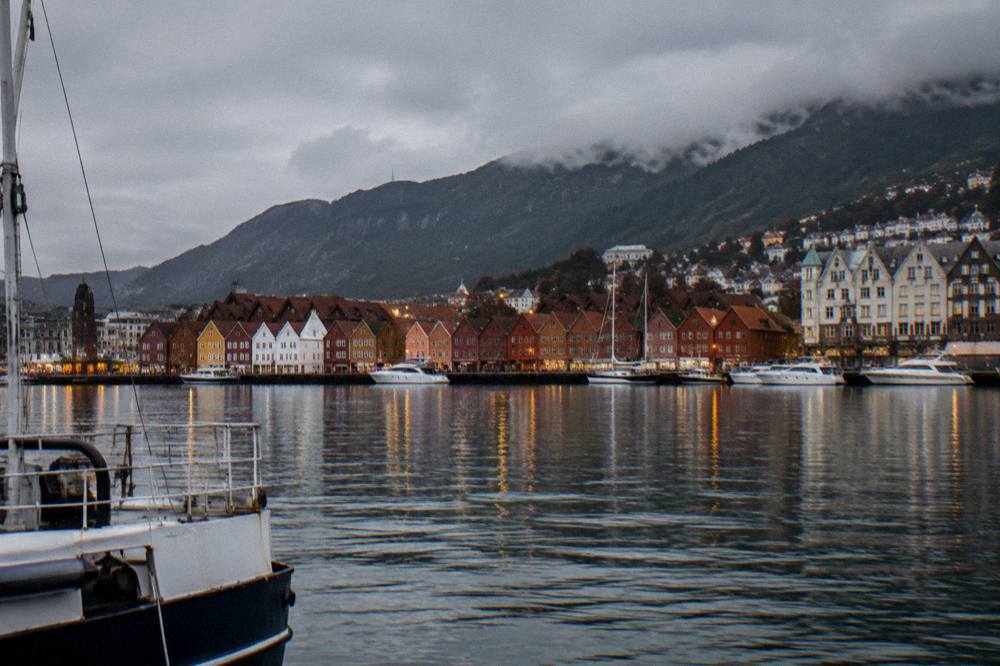
Bergen Currency And Tipping: How Money Works In Bergen, Norway
Bergen, in Vestland county on Norway's southwestern coast, runs on the Norwegian krone, card payments and a tipping culture that is far more relaxed than many people assume. This guide covers the currency, what to tip, the 2026 Bergen Card prices and how to plan everyday spending.
Short answer
Bergen uses the Norwegian krone (NOK), not the euro. Tipping is never required: rounding up a restaurant bill or leaving a few percent is a polite gesture, not an obligation. Cards are accepted almost everywhere, and the 2026 Bergen Card costs from 400 NOK for 24 hours.
Bergen, a city and municipality in Vestland county on Norway's southwestern coast, runs on the Norwegian krone, near-universal card acceptance and a tipping culture that surprises almost every visitor arriving from the United States or the United Kingdom. Nobody in Bergen expects a service charge on top of the bill, because Norwegian restaurant prices already carry everything. What the city does expect is that you understand the krone before you arrive, because the alternative, arriving with euros or dollars in hand, leads to a small parade of avoidable fees at the exchange desk. This guide from Bergen Travel Guide covers the currency itself, the tipping question that brings more search traffic than any other money topic, the 2026 Bergen Card prices straight from the official flyer, and what everyday spending actually looks like across restaurants, transport and attractions.
What Currency Does Bergen, Norway Use?
Bergen uses the Norwegian krone, abbreviated NOK and symbolised as kr, and nothing else. Norway is not an EU member, so the euro has no legal status here, and no shop, restaurant or ticket office in Bergen is obliged to accept it. The krone is the currency confirmed across every official source for this site, from the Bergen Card flyer to Skyss transport pricing, and all figures in this guide are quoted in NOK.
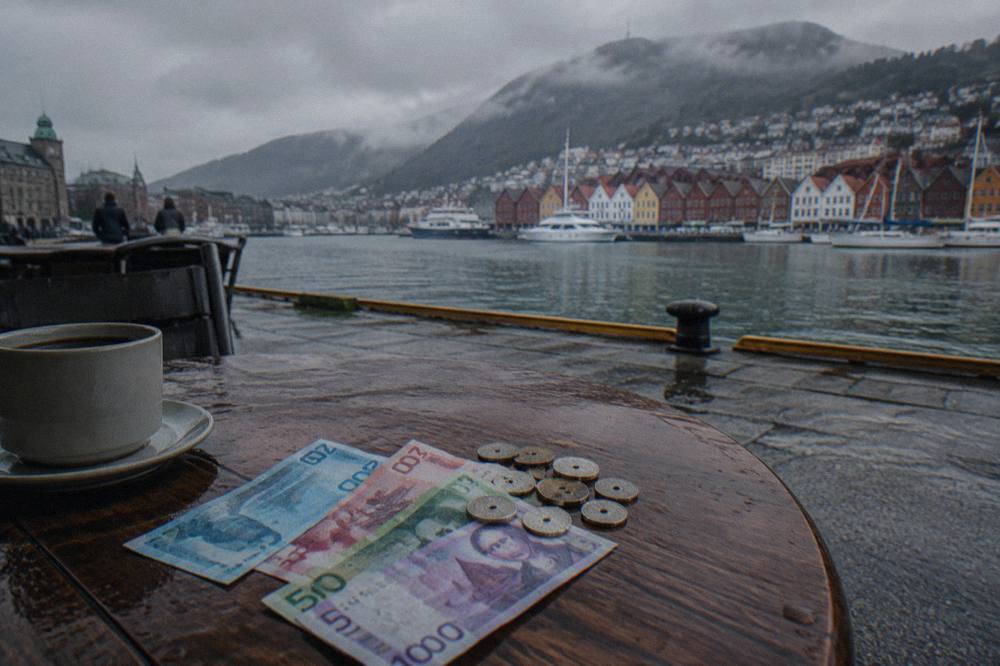
The krone is a decimal currency: 100 ore make up one krone, although ore coins were withdrawn from circulation years ago and prices are simply rounded. Banknotes come in denominations of 50, 100, 200, 500 and 1000 NOK, and coins in 1, 5, 10 and 20 NOK. The 20 NOK coin is the one you will handle most, because it is the standard coin for small purchases and lockers.
A common mistake is assuming that because Norway is in Europe, it is in the EU and therefore in the eurozone. It is not. Norway is an EEA and EFTA member, a Schengen Associate applying the Schengen acquis, but not an EU member state. The practical consequence for a visitor is simple: your euro-denominated travel money is a foreign currency in Bergen, exactly as much as US dollars are. Exchange it, or better, do not carry it at all and pay by card, which is the local default.
For planning context beyond the money itself, our planning a trip to Bergen guide walks through the full arrival sequence, and the Bergen airport guide covers getting from Flesland into the city centre.
Do You Tip At Restaurants In Bergen, Norway?
No, tipping at restaurants in Bergen is not expected and never obligatory. Norwegian restaurant bills already include service, and waiting staff earn full wages under Norwegian labour law, so there is no tipping wage to top up. Rounding up the bill, or leaving roughly 5 to 10 percent for genuinely good service, is a friendly gesture that locals make occasionally, but leaving nothing at all is completely normal and no waiter will think twice about it.
This is the single biggest gap between Bergen's dining culture and North America's. In the United States a tip is part of the server's income; in Norway it is a small, optional thank you. If a Bergen restaurant bill comes to 485 NOK, a local might round up to 500 NOK and say "keep the change", or simply pay the exact amount by card. Both are equally polite.
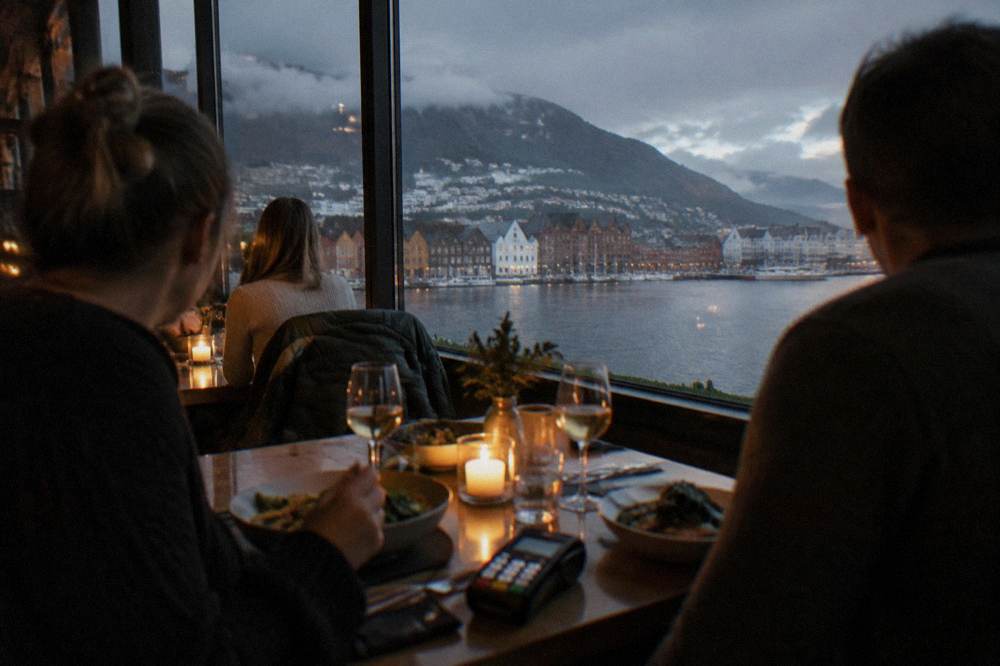
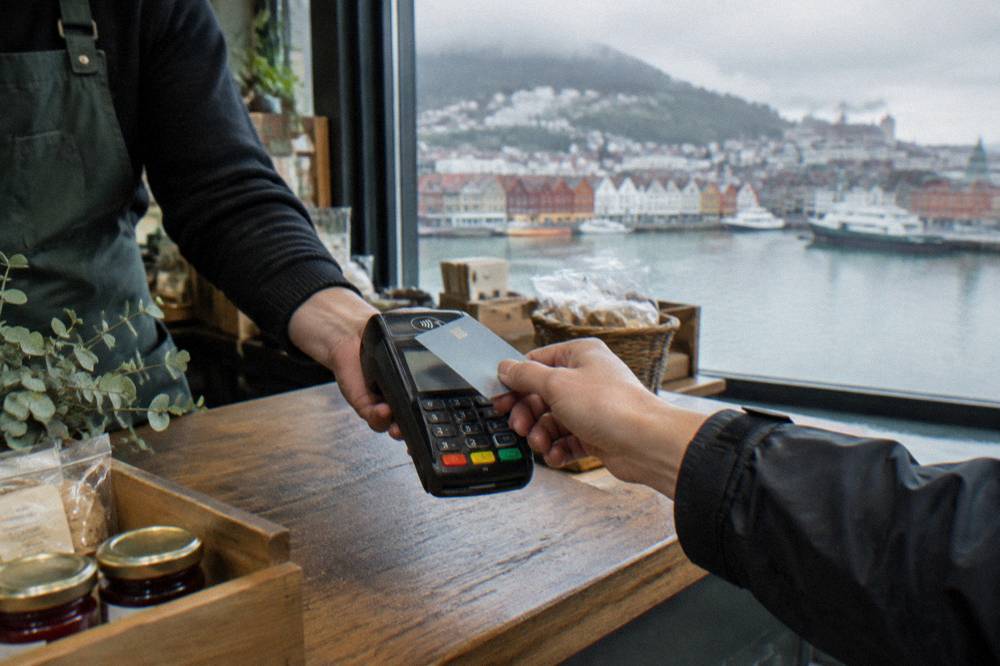
The card terminal is where most tipping decisions actually happen. When you pay by card in a Norwegian restaurant, the terminal usually offers a keypad screen where you can enter the amount yourself before entering your PIN. If you want to round up, this is the moment: type in a slightly higher figure. If you do not want to tip, enter the exact amount. There is no separate tip line on the printed receipt the way there is in the US.
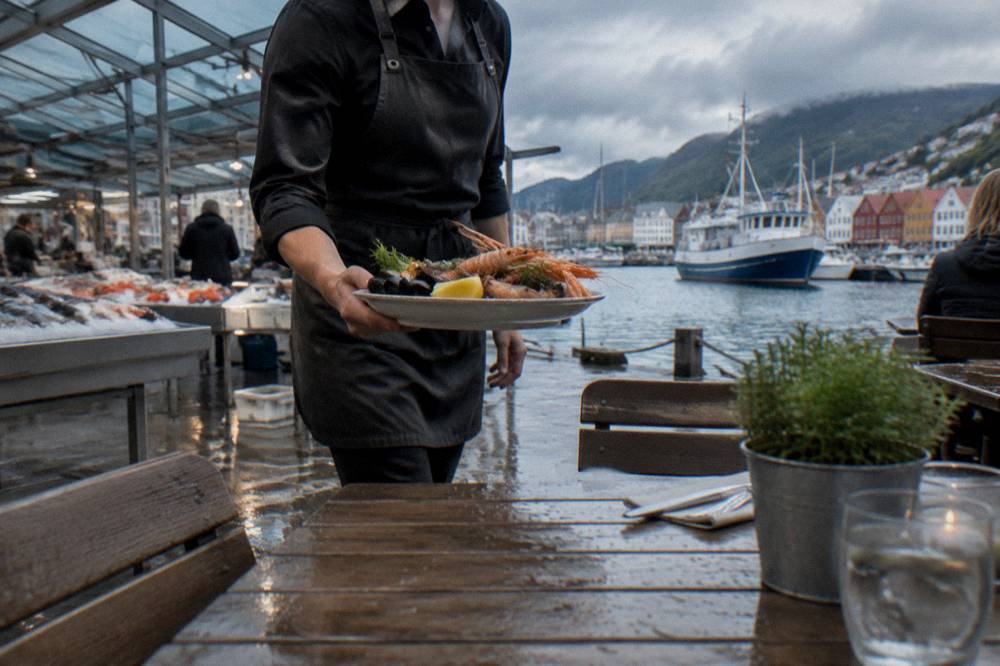
Tipping elsewhere follows the same logic. Taxi drivers are not tipped, though rounding up is not rude. Hotel housekeeping staff are not tipped. Hairdressers and spa staff are not tipped. Tour guides on paid tours are not tipped as a rule, although on the free, tip-based walking tours run through GuruWalk the tip is the entire business model, so there you decide the value yourself at the end. Bartenders are not tipped; if you hear that buying a round for your own table is the Norwegian way of spending generously, that is true, but it has nothing to do with tipping staff.
For where that restaurant money goes, our best restaurants in Bergen guide covers the dining scene, and if you want the city's food culture explained while you eat your way around it, the Food and Culture Walk is the tour built for exactly that.
If you are weighing Bergen's overall costs rather than its customs, the companion piece on how expensive Bergen is breaks the budget question down day by day.
How Much Does The Bergen Card Cost, And Is It Worth The Money?
The 2026 Bergen Card costs 400 NOK for an adult 24-hour pass and 100 NOK for a child aged 3 to 15, with 48-hour, 72-hour and 96-hour versions at 500, 600 and 700 NOK for adults, according to the official Bergen Card flyer published on visitbergen.com in May 2026. It includes free Skyss buses and the Bybanen light rail across Vestland county, including the airport line, plus free or discounted entry to most major attractions.
The flyer is the single best primary source for attraction pricing in the city, and it is worth reading the inclusions against your own plan. The card's transport coverage alone is substantial: a Skyss single adult ticket in zone A costs 51 NOK, so a visitor making several bus or light rail journeys plus a museum or two per day can cross the 400 NOK line quickly.
| Bergen Card 2026 | Adult (NOK) | Child 3-15 (NOK) |
|---|---|---|
| 24 hours | 400 | 100 |
| 48 hours | 500 | 125 |
| 72 hours | 600 | 150 |
| 96 hours | 700 | 175 |
Source: official Bergen Card 2026 flyer, visitbergen.com.
| Attraction (2026 prices) | Ordinary adult price | With Bergen Card |
|---|---|---|
| Fløibanen funicular return (Apr-Sep) | 200 NOK | Discounted, one per card |
| Fløibanen funicular return (Oct-Mar) | 145 NOK | Discounted, one per card |
| Ulriken643 cable car return | 435 NOK | Discounted |
| The Aquarium (Akvariet) | 380-415 NOK seasonal | Included or discounted |
| Bryggen Museum | 170 NOK | 85 NOK |
| Hanseatic Museum with guided visit | 160 NOK | Included or discounted |
| Haakon's Hall | 120 NOK | Included or discounted |
| KODE Art Museums | Standalone price not published on the flyer | 200 NOK listed |
Source: official Bergen Card 2026 flyer and ulriken643.no pricing pages.
The KODE line deserves a caveat: the 200 NOK figure is the Bergen Card flyer's own bundled line item, not KODE's confirmed standalone adult price, so treat it as the card price rather than the walk-up price. Our full Bergen Card guide works through the arithmetic for one-day, two-day and family scenarios.
One freshness note for anyone planning a winter trip: the Ulriken643 cable car has a scheduled maintenance closure in weeks one and two of 2026, reopening around 13 January, plus standard Christmas closures, so a card purchased for the views should be timed around that window.
Do You Need Cash In Bergen, Or Is Card King?
Card is king in Bergen to a surprising extent: contactless and PIN-based card payment is accepted at virtually every shop, cafe, restaurant, museum ticket desk and even many public toilets, and many smaller operators are effectively card-only. Cash is still legal tender, but carrying a wallet of krone notes is unnecessary for almost any transaction a tourist will make in the city.
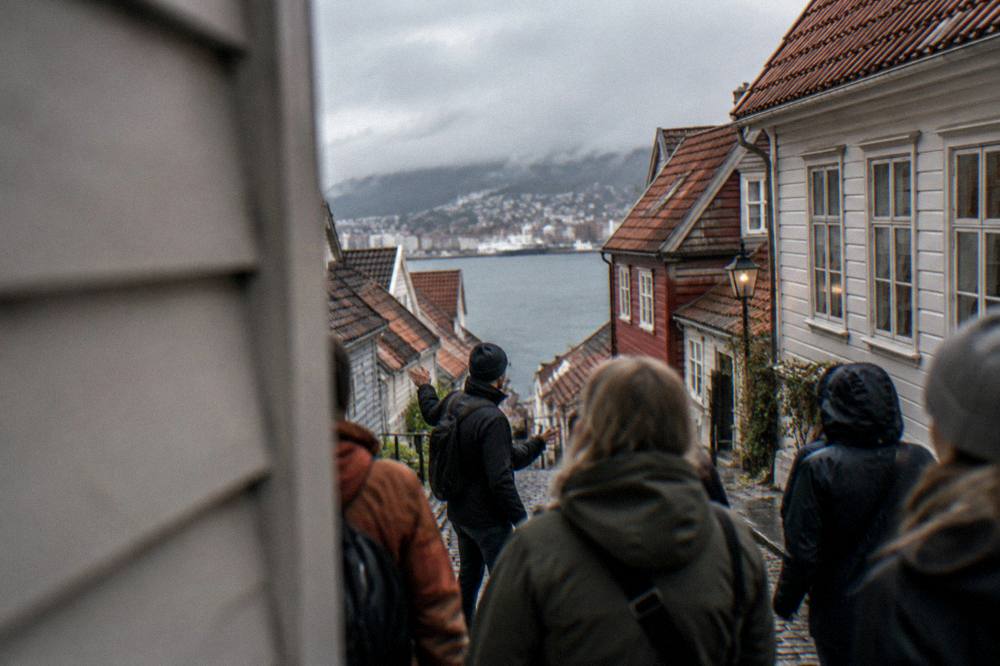
The one genuine cash scenario left is the tip-based free walking tour. The GuruWalk free tours of Bergen operate on tips alone, so whatever you decide to give the guide at the end is the entire payment, and cash makes that moment easier, though many guides accept a card tap through their own terminals. If you plan to join one, carry a few hundred kroner in small notes for the end of the walk.
Foreign cards work without friction almost everywhere. Contactless works for purchases under a threshold set by the terminal, above which a PIN is required, so know your card's PIN before you travel. Mobile wallets behave the same as physical cards. Our page on using Apple Pay in Bergen covers the phone-payment specifics.
| Payment situation in Bergen | Card accepted | Cash needed | Notes |
|---|---|---|---|
| Restaurants and cafes | Yes | No | Terminal lets you enter a rounded amount if you wish to tip |
| Museums and attractions | Yes | No | Bergen Card is itself a card or app pass |
| Skyss buses and Bybanen light rail | Yes | No | Ticket machines and app both take card |
| Market stalls at Fisketorget | Yes, mostly | Rarely | Some vendors prefer card, carry a little cash if worried |
| Tip-based free walking tours | Often | Useful | Tip is the guide's entire payment |
| Public toilets | Often card-only | Sometimes | A genuine last refuge of coins |
Two cautions. First, avoid airport currency-exchange desks and their spread on the krone; paying by card and letting your bank set the rate is almost always cheaper, and always choose to be charged in NOK rather than your home currency when a terminal offers dynamic currency conversion. Second, notify your bank or check your card's foreign transaction fee before the trip, since a percentage fee on every tap adds up quickly in a city where prices are already high.
What Do Tipping And Payment Norms Look Like On Bergen Tours?
Paid tours in Bergen do not carry a tipping expectation: the price on the operator's listing is the full price, guides are salaried or contracted, and no tip line appears anywhere in the booking flow. The exception is the free walking tour, where the tip is the payment by design. On paid fjord cruises, food walks and private tours, rounding up or saying thanks verbally is the local ceiling of generosity, and nothing more is expected.
This matters because visitors often arrive with a mental rule from home, ten to twenty percent on tours, and apply it reflexively. In Bergen that money is genuinely optional. If a guide has been exceptional, a small amount handed over at the end is received warmly; if not, nothing happens. There is no social penalty.
The booking side of tour spending has its own logic. Prices, ratings and durations for bookable tours render from the operator's live listing, and those figures can shift with season and demand, so check the listing rather than a cached number. Cancellation terms also live on the listing: many Bergen tours offer free cancellation up to a day before departure and a pay-later option, which is worth using in a city where Met Norway's own station table shows 217 days with precipitation over the trailing 13 months, and plans sometimes need to move with the weather.
If a rainy forecast pushes you toward a longer, weather-proof splurge, the two-day Grand Sognefjord round trip is the biggest-ticket option in the roster.
For the classic half-day on the water, the Mostraumen fjord cruise operated and guided by locals is the mid-priced standard.
Our fjord tours from Bergen guide compares the full range, and the getting around Bergen guide covers the transport side once you are back on land.
What About Tax Refunds, VAT And Shopping In Bergen?
Norway charges a value-added tax, known as moms, on goods, and non-resident visitors can in principle reclaim VAT on purchases exported out of the country, but the practicalities matter: refunds apply to goods, not services or hotel stays, minimum purchase thresholds apply per store, and the paperwork must be stamped and processed at departure. Since Norway is outside the EU but inside the Schengen area, the refund process is a separate Norwegian system, not the EU's.
For most visitors this is a niche exercise rather than a money-saving pillar. The purchases that make it worthwhile are genuinely expensive goods, think wool outerwear, jewellery or design pieces, bought in a single store and exported in your luggage. Restaurant meals, hotel nights, transport and tour tickets are all services and are simply not eligible, which covers most of what a typical Bergen visitor spends.
| Spending category | VAT refundable for visitors | Notes |
|---|---|---|
| Restaurant and cafe meals | No | Service, not an exported good |
| Hotel accommodation | No | Service |
| Tour and cruise tickets | No | Service |
| Wool knitwear and clothing | Yes, above the store's minimum | Exported goods only, paperwork required |
| Design and jewellery purchases | Yes, above the store's minimum | Ask the store for refund documentation at purchase |
| Food and groceries | Generally not worthwhile | Thresholds rarely met |
Ask at the till before paying whether the shop offers visitor VAT refund documentation; not every Bergen shop participates, and the refund is processed after the goods are shown at departure. For the shopping itself, our shopping in Bergen guide maps the streets and stores worth the wallet.
How Should You Budget Money For A Bergen Trip?
Budget for Bergen by accepting three fixed reference points from the official 2026 sources: the Bergen Card starts at 400 NOK for 24 hours, a Skyss single in zone A costs 51 NOK, and the headline attraction prices run from 120 NOK at Haakon's Hall to 435 NOK for the Ulriken643 cable car return. Everything else, food and lodging especially, varies by season, so build the day around the card's coverage and let the card's included transport absorb your local travel costs.
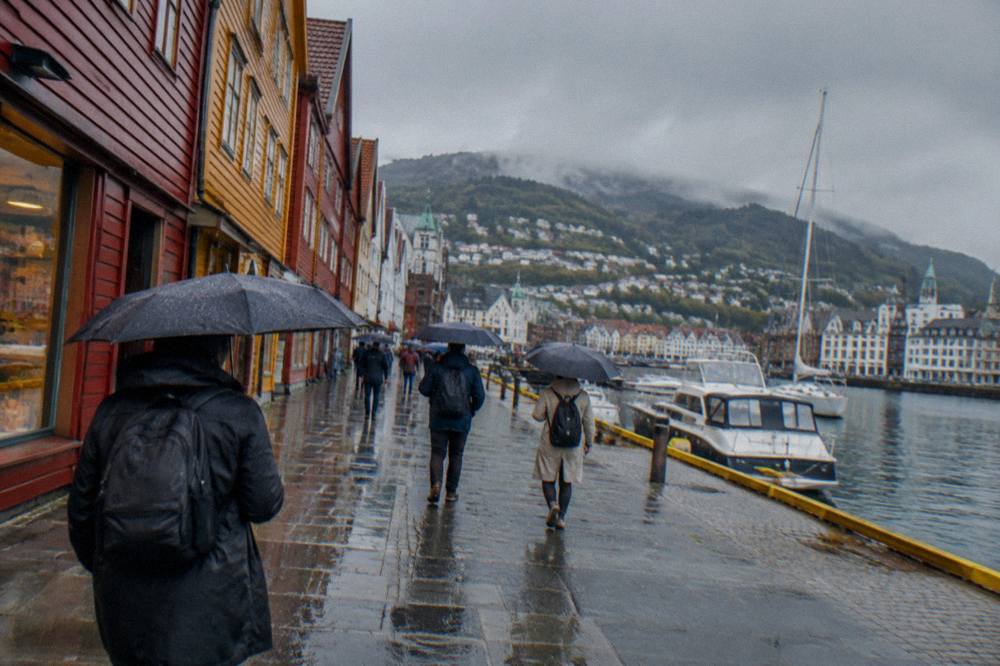
The seasonal angle is real. Bergen's climate is temperate oceanic, wetter than most of Norway: the yr.no Met Norway table for the Bergen station shows monthly mean temperatures from -1.4C in January 2026 to 14.9C in July 2026, and November's observed precipitation of 321.8mm against a 275.0mm normal makes it the wettest month in the current table. Rain does not stop the city, but it shifts spending indoors, toward museums and food, which is exactly the mix the Bergen Card covers.
| Bergen budget element | 2026 reference figure | Source |
|---|---|---|
| Bergen Card 24h adult | 400 NOK | Official flyer, visitbergen.com |
| Bergen Card 96h adult | 700 NOK | Official flyer, visitbergen.com |
| Skyss single, zone A | 51 NOK | visitbergen.com transport page |
| Fløibanen return, summer | 200 NOK | Official flyer |
| Ulriken643 return | 435 NOK | ulriken643.no |
| Aquarium adult | 380-415 NOK seasonal | Official flyer |
| Haakon's Hall | 120 NOK | Official flyer |
For timing the trip against your budget, the best time to visit Bergen guide weighs price against weather, the where to stay in Bergen guide covers the accommodation districts, and the Bergen in winter guide looks at the cheapest, quietest season of all.
Common Questions About Money And Tipping In Bergen
Do you tip at restaurants in Bergen, Norway?
No. Tipping in Bergen restaurants is optional and never expected, because Norwegian bills already include service and staff earn full wages. Rounding up the bill or leaving a small percentage for excellent service is a kind gesture, and paying the exact amount is equally normal.
Can I use euros in Bergen?
No. Norway is not an EU member and the euro has no legal status in Bergen. The currency is the Norwegian krone (NOK). Some tourist-facing shops may accept euros at a poor rate, but you should not plan on it.
Should I bring cash to Bergen?
Almost none. Card payment is accepted virtually everywhere in Bergen, including transport, museums and market stalls. The main reason to carry a few hundred kroner in cash is a tip-based free walking tour, where the tip is the guide's entire payment.
Do you tip taxi drivers or hotel staff in Bergen?
No. Taxi drivers, hotel housekeeping staff and spa workers in Bergen are not tipped. Rounding up a taxi fare is not rude, but it is not expected either.
Is the Bergen Card worth the money?
It depends on your pace. The 24-hour card costs 400 NOK for an adult and includes free Skyss buses and the Bybanen light rail across Vestland county, including the airport line, plus free or discounted entry to most major attractions. A visitor combining several attractions and bus journeys per day will typically come out ahead.
Can visitors get a VAT refund on purchases in Bergen?
Yes, in principle, on exported goods bought above a participating store's minimum threshold, with refund documentation stamped at departure. Services, meals, hotels and tour tickets are not eligible, so for most visitors the refund only matters for expensive goods like wool outerwear or jewellery.
The short version of all of this: Bergen is a card city with a no-pressure tipping culture, and the money you save by not tipping fifteen percent everywhere is better spent on a fjord cruise or a second day of the Bergen Card. Plan the krone amounts around the official flyer figures, keep a little cash for a free walking tour guide, and the financial side of the trip takes care of itself.