Bergen Street Art
Bergen, in Vestland county on Norway's southwestern coast, is famous for its Hanseatic wharf and its rain, but its side streets, laneways and underpasses carry a shifting layer of murals, paste-ups and stencils that most itineraries never mention. This guide covers where to look, when to go, and what it costs to build a day around the city's walls.
Short answer
Bergen's street art is concentrated in the central laneways between the city centre and the harbour, in the student-and-shopping quarter around Marken and Skostredet, and along the older residential slopes of Nordnes and Sandviken. Nothing is ticketed: you see it on foot, for the price of a Skyss ticket (51 NOK for a single zone A adult fare) or nothing at all. Bring a rain layer, because yr.no's Bergen station table shows 217 days with precipitation over the trailing 13 months.
Bergen, a city and municipality in Vestland county on Norway's southwestern coast, is sold to the world on Bryggen, Fløyen and the fjords. The walls tell another story. Between the timber facades and the stone foundations of a former Hanseatic League trading post, a rotating stock of murals, paste-ups, stickers and stencils comes and goes with the weather, and almost none of it is on a ticket. Hunting it is one of the genuinely free things to do in Bergen if you know which slopes and laneways to walk, and it pairs naturally with the paid landmarks because the art and the sights share the same compact centre.
This guide is written by an editorial desk, not by someone who has walked these streets: every figure below comes from a primary source such as the official 2026 Bergen Card flyer published by visitbergen.com, or from yr.no's Bergen station statistics table, and where a figure was never confirmed it simply does not appear. What follows is a planning framework: which neighbourhoods to walk, how the coastal rain shapes what you will see, what a day built around the walls costs in Norwegian kroner, and how to bolt a street-art walk onto the sights you were already going to visit.
What Is The Bergen Street Art Scene Like?
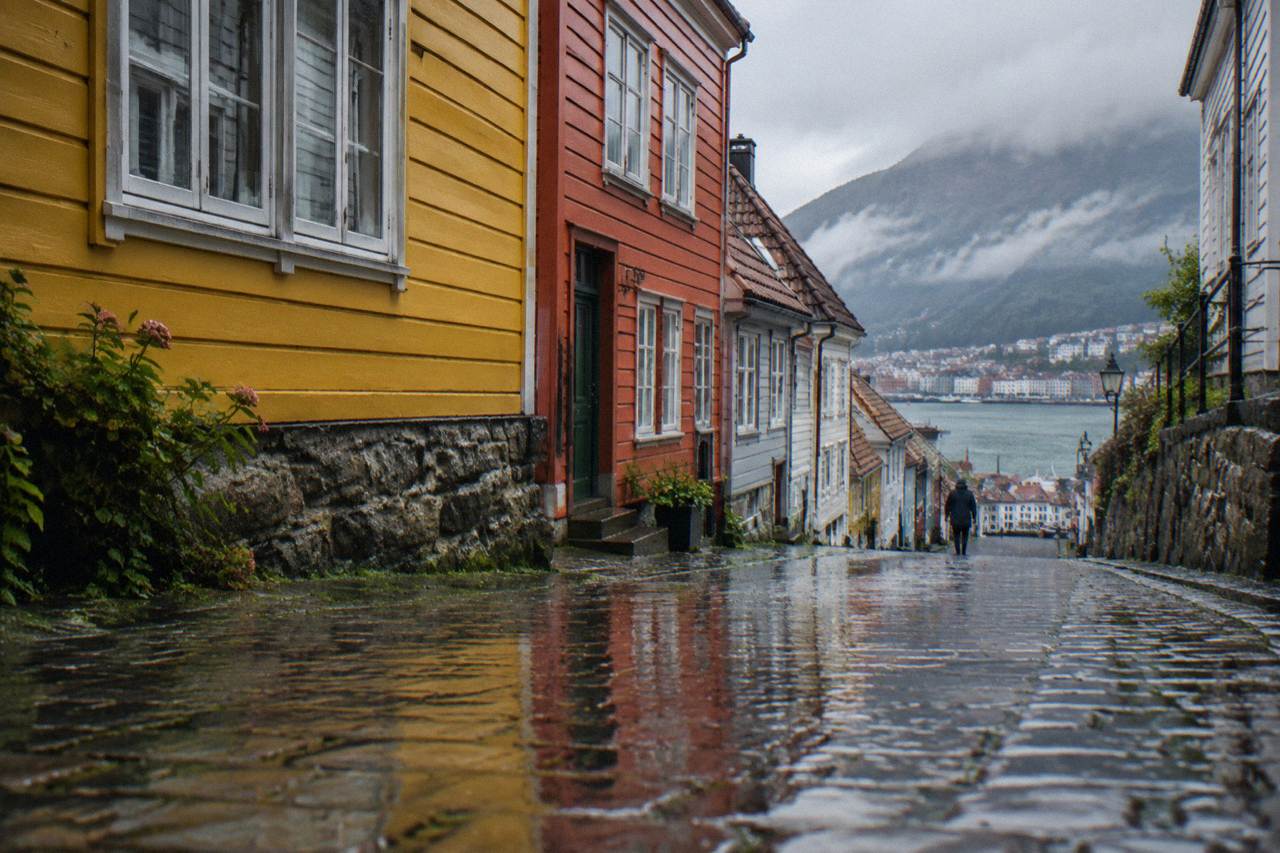
Bergen's street art is small-scale, fast-changing and weather-beaten rather than monumental: think laneways, gable ends, shutters, transformer boxes and underpasses rather than festival-scale murals, in a compact city of 294,860 people (Bergen kommune, 1 January 2026) where the whole scene sits within walking distance of the harbour. Nothing is curated or ticketed, and yr.no's Bergen station table shows 217 days with precipitation over the trailing 13 months, so surfaces age quickly.
That transience is the point: the same lane can look different two months apart.
The scale matters. This is not a city of giant commissioned walls you cross town for; it is a city where you find a stencil on a shutter while looking for a bakery. The compactness works in your favour. The distance from the harbour to the slopes of Sandviken is a short walk on ordinary city streets, so a wall-hunting route can be stitched together between coffee stops without any transport at all, which matters when a single adult Skyss ticket in zone A costs 51 NOK per journey.
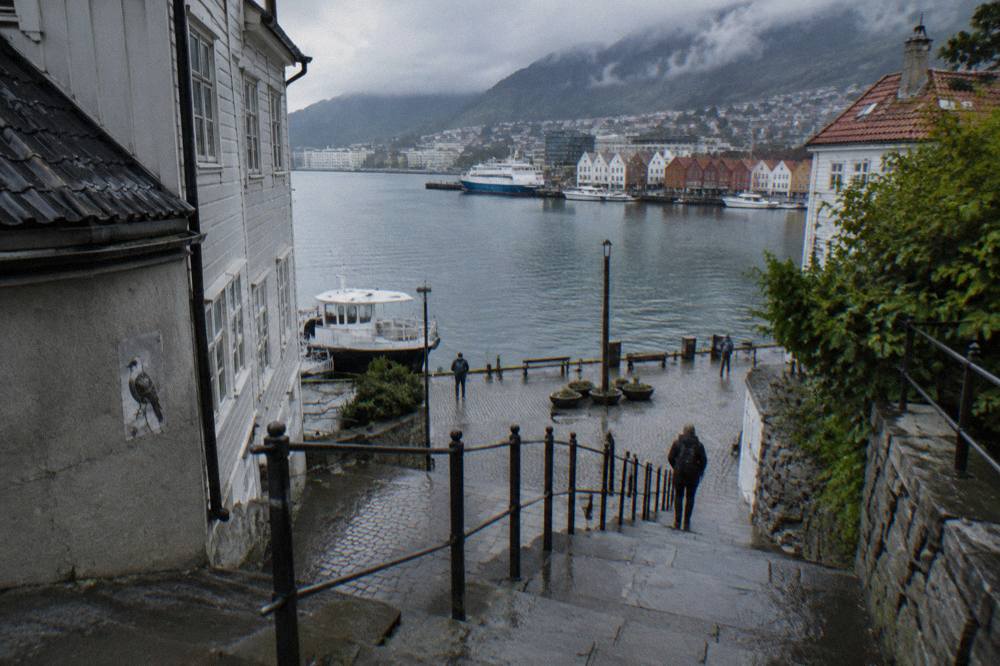
There is also a historical frame that visitors tend to miss. Bryggen, the old Hanseatic wharf, was inscribed on the UNESCO World Heritage List in 1979, and its strict conservation rules mean the painted experiment in Bergen lives everywhere except its most photographed front row. The contrast is the interesting part: one of Europe's most protected wooden townscapes sits a few lanes away from surfaces that nobody protects at all.
The scene's rhythm is seasonal in a second way. Commercial streets with shutters and side walls see the most turnover, because shutters get replaced and side walls get repainted when businesses change hands. Residential slopes see less. Planning around that difference is most of the strategy.
Where To Find Street Art In Central Bergen
The productive core is the grid of narrow streets immediately behind and above the harbour front: the commercial laneways of the city centre, the shopping quarter around Marken and Skostredet, and the connecting lanes that climb toward the Fløyen lower station. These are streets with shutters, gable ends, side walls and passers-by, exactly the surface mix street art favours, and all of it lies within the footprint already walked between Bryggen and Torgallmenningen. Nothing in this zone requires a ticket: it is a walking district.
Start on the harbour side and work uphill. The logic is simple: the flat, commercial, high-footfall streets carry the fast-changing stock, and the further you climb into residential timber quarters, the sparser and more weathered it gets. A sensible loop is the harbour front, then the laneways behind it, then the Marken and Skostredet shopping streets, and only then, if your legs agree, the slopes.
| Central zone | Surface type you are looking for | Turnover | Best paired with |
|---|---|---|---|
| Laneways behind the harbour front | Shutters, gable ends, side walls | High, changes with tenants | Bryggen and the Fish Market |
| Marken and Skostredet quarter | Shopfronts, shutters, rear walls | High in the shopping streets | Cafes and independent shops |
| Streets climbing toward the Fløyen lower station | Retaining walls, boxes, passageways | Medium | The funicular ride up |
| Torgallmenningen and the main squares | Boxes, hoardings, event remnants | Medium, event-driven | People-watching and rest stops |
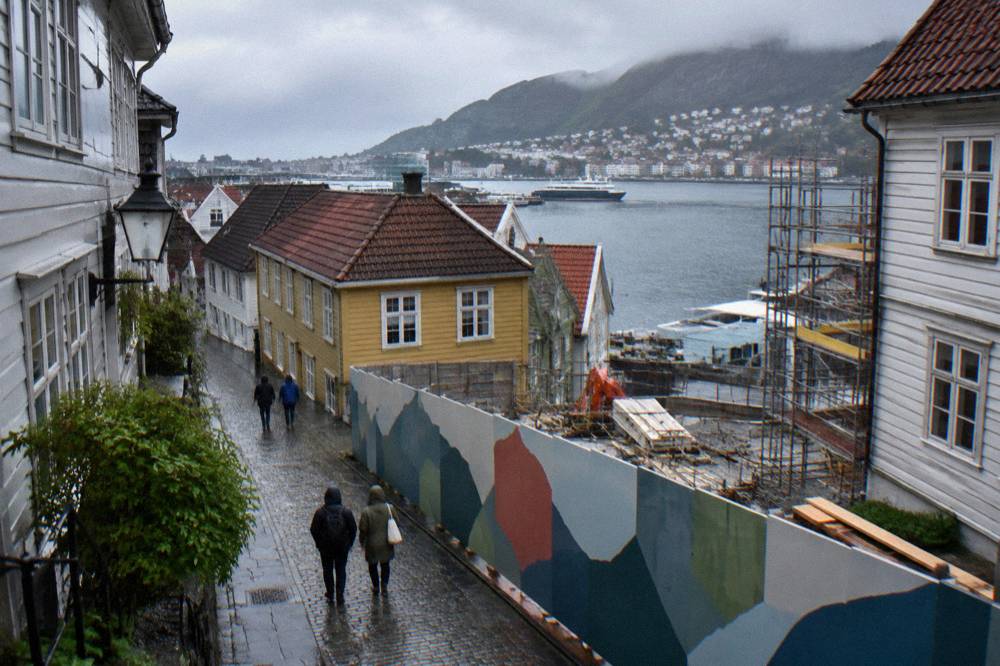
Two practical notes from this desk. First, shutters mean timing: painted shutters are visible only when shops are closed, so an early-morning or Sunday walk shows you walls that a midday walk hides. Second, hoardings and temporary fencing around any construction site are often the most painted surfaces in a Scandinavian city centre, and they vanish when the project ends, so treat anything on them as seasonal.
For a broader orientation before you go, the planning guide to a Bergen trip covers the geography of the centre, and getting around Bergen covers the buses and light rail you will need once you step outside the walkable core.
Which Bergen Neighbourhoods Hide The Best Street Art?
Beyond the centre, the strongest neighbourhoods are Marken and Skostredet for sheer density of paintable commercial frontage, Nordnes for a quieter peninsula mix of timber houses and harbour-side walls, and Sandviken for weathered slopes where murals fade fastest. All four are ordinary residential and commercial areas, not galleries: nobody maintains the walls, so what you see is whatever has survived the last wet season. Each pairs with a sibling attraction, which makes them efficient stops rather than detours.
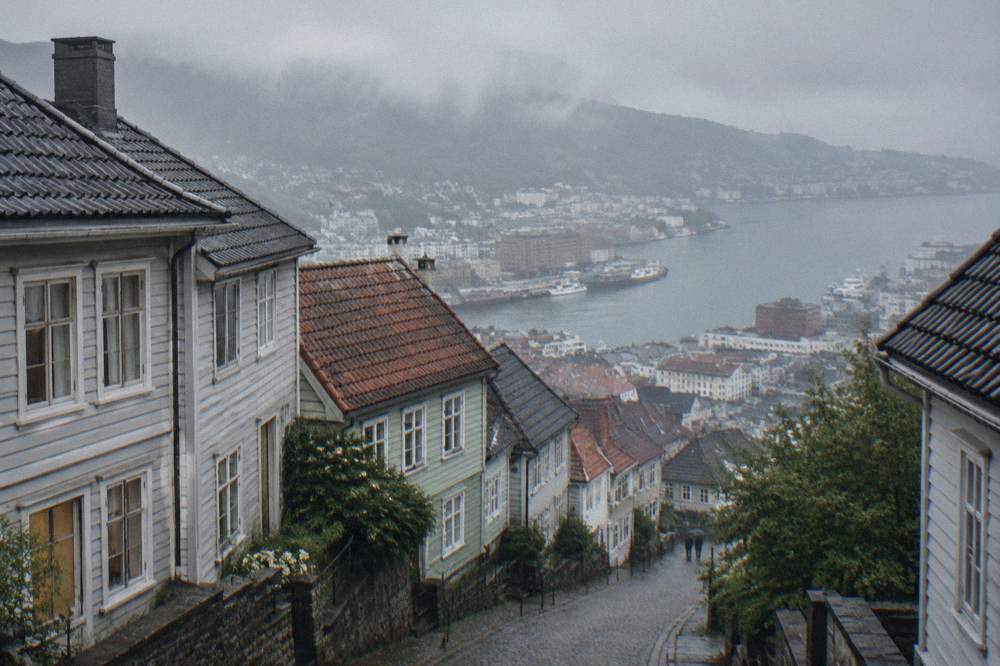
The neighbourhoods differ in character more than in volume. Marken and Skostredet are the dense shopping quarter, so they give you shutters and shopfronts in quick succession. Nordnes is the peninsula holding the aquarium and quiet timber streets, so walls there sit among domestic scenes and small gardens. Sandviken climbs the slope north of the harbour, older and quieter, and its exposed surfaces take the weather hardest.
This is also where a guided walk earns its place, because a local guide knows which wall survived last winter and which lane repainted in spring. The roster's walking options include the Past and Present small-group guided walking tour, which covers the central districts where most of the paint is, and there is a strong argument for pairing the walls with the food: Bergen's central lanes are the same lanes where the city's food culture lives, covered in the best restaurants guide.
The strongest single pairing for a street-art-leaning day, though, is the Food and Culture Walk, which threads central Bergen on foot with tastings along the way, and the operator's live listing carries the current price, rating and review count. Its route and the wall-hunting loop overlap almost entirely, which is why this guide features it.
If you would rather build the whole day around art, food and the fjord in one pass, these three options bracket the range: a culture-and-tasting walk in the central lanes, a scenic Hardangerfjord day trip with lunch and waterfalls, and a long fjord cruise ticket toward Flåm.
How Does Bergen's Rain Shape Its Street Art?
Bergen's climate is temperate oceanic and wetter than most of Norway: yr.no's Bergen station table (Met Norway data) shows monthly means from -1.4C in January 2026 to 14.9C in July 2026, with monthly precipitation ranging from 65.9mm to 321.8mm across the trailing 13 months and 217 days with precipitation in total. For painted and pasted surfaces that means fast fading, peeling paste-ups and a scene that visibly regenerates, and for you it means a rain layer on every walk, any month.
The numbers are worth reading rather than paraphrasing, because the wet months concentrate hard. Here is the trailing-13-month picture from the official table:
| Month | Mean temp (observed) | Precipitation (observed mm) |
|---|---|---|
| September 2025 | 13.1C | 206.6 |
| October 2025 | 9.7C | 231.9 |
| November 2025 | 6.0C | 321.8 |
| December 2025 | 5.8C | 303.5 |
| January 2026 | -1.4C | 82.0 |
| February 2026 | 0.8C | 133.4 |
| March 2026 | 5.9C | 243.9 |
| April 2026 | 7.9C | 65.9 |
| May 2026 | 9.9C | 127.4 |
| June 2026 | 14.4C | 165.7 |
| July 2026 | 14.9C | 184.2 |
| August 2026 | 14.3C | 243.6 |
Two readings matter for wall hunters. November, at 321.8mm, is the wettest month in the table and the worst month to judge any mural by, because everything looks tired in November. April, at 65.9mm observed against a 141.0mm normal, was unusually dry in this period, and late spring is when repainted shutters and fresh paste-ups are most likely to have survived intact. The Bergen weather guide carries the full month-by-month picture for trip planning.
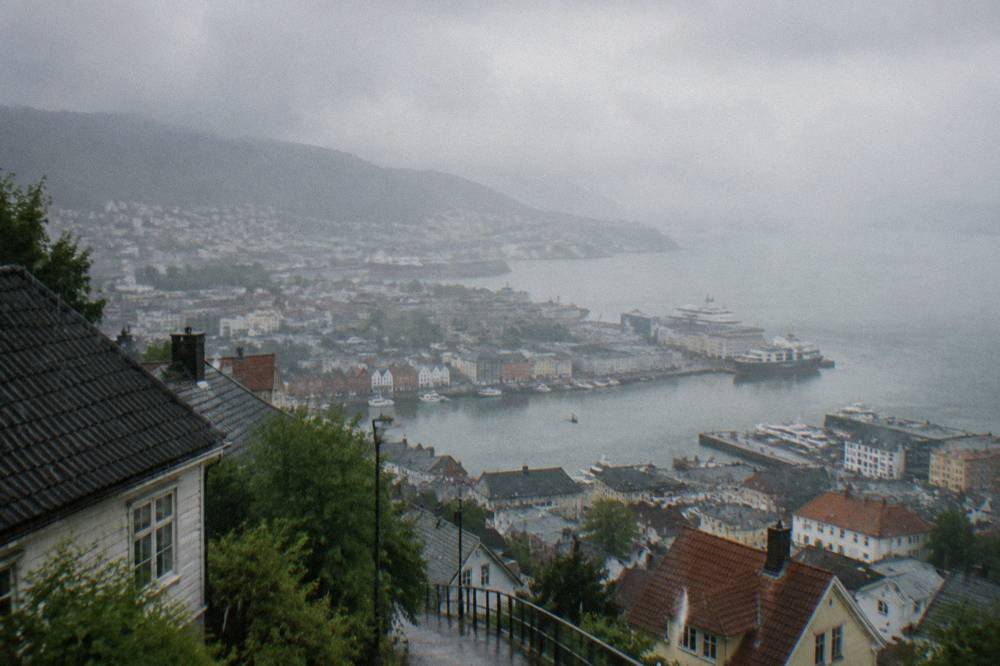
The practical takeaway is not to schedule around the rain, because in Bergen you cannot. The takeaway is to schedule the photography around it: overcast, post-rain light is flat and saturated, which flatters painted surfaces, whereas low winter sun off wet cobblestones can blow out colour. A wall that looks dull at noon can look rich at four in the afternoon after a shower.
Can You Combine Street Art With Bergen's Main Sights In One Day?
Yes, easily, because everything shares one compact footprint: a realistic day walks the harbour laneways and Marken in the morning, rides the Fløyen funicular (a return adult ticket is 200 NOK from 1 April to 30 September, 145 NOK from 1 October to 31 March, per the official Bergen Card flyer) or takes the Ulriken643 cable car (435 NOK adult return) for the view, and returns through Sandviken or Nordnes in the late afternoon when the shutters start coming down. The sights and the walls are the same walk.
The money is the part worth planning, because the big-ticket items add up fast. The same 2026 flyer, published by visitbergen.com on 12 May 2026, gives these ordinary adult prices:
| Item | Ordinary adult price | Source note |
|---|---|---|
| Fløyen funicular return, 1 Apr to 30 Sep | 200 NOK | Bergen Card 2026 flyer |
| Fløyen funicular return, 1 Oct to 31 Mar | 145 NOK | Bergen Card 2026 flyer |
| Ulriken643 cable car return | 435 NOK | ulriken643.no price page |
| KODE Art Museums, listed price | 200 NOK | Bergen Card flyer line item; KODE's own standalone price is not published on the flyer |
| The Aquarium, 1 Nov to 28 Feb | 380 NOK | Bergen Card 2026 flyer |
| The Aquarium, 1 Mar to 31 Oct | 380 to 415 NOK seasonal | Bergen Card 2026 flyer |
| Haakon's Hall | 120 NOK | Bergen Card 2026 flyer |
| Hanseatic Museum, with guided visit | 160 NOK | Bergen Card 2026 flyer |
| Bryggen Museum | 170 NOK, 85 NOK with Bergen Card | Bergen Card 2026 flyer |
| Skyss single ticket, zone A | 51 NOK | visitbergen.com travel information page |
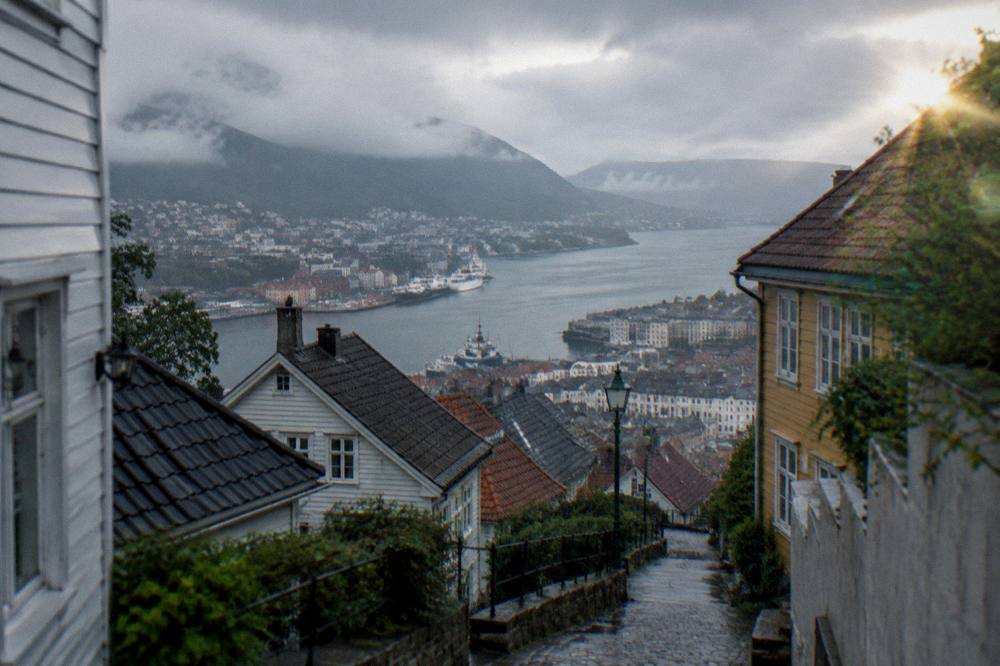
The street-art layer of this day is free, which is the entire argument for it. A sensible shape: harbour laneways and Bryggen's back rows in the morning while shops are still closed and shutters are up, the funicular at midday, then Marken and Skostredet in the afternoon when the shopping streets are busy, and a final hour in Nordnes or Sandviken where the timber-house slopes photograph well in late light. If that sounds like a full day, it is, and the one day in Bergen itinerary is the template to bend around it.
Do You Need A Guided Tour To Find Street Art In Bergen?
No, because the productive streets are the ones every visitor already walks, and a self-guided loop between the harbour, Marken and Skostredet costs nothing but shoe leather. A guided tour adds value for different reasons: context on what you are looking at, a schedule that survives bad weather, and, on the food-and-culture end of the roster, tastings in the same lanes. If your day is short or your weather is bad, a guide converts a scattered hunt into a guaranteed two or three productive hours.
The honest trade-off is this: self-guided is free and flexible, but transience means you may walk a lane the week after a wall was repainted. A guide cannot promise walls either, but a good one routes around dead spots and layers history onto whatever is there. For pure city context, the solo pick below is the highest-reviewed walking option on the roster's decision name, and its live listing carries the current price and rating.
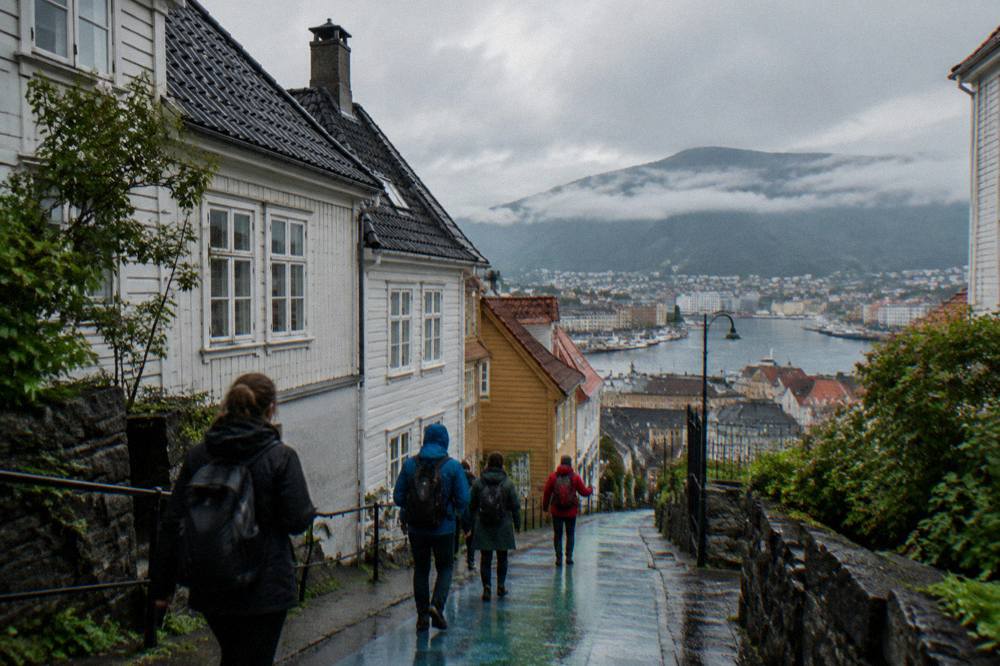
There is also a free option worth naming plainly. GuruWalk runs free, tip-based walking tours in Bergen, including comedy-and-history walks that cover the central districts where the street art concentrates; nothing is paid up front and the guru works for tips. The tip-based model makes it the cheapest possible way to have someone else structure your lane-walking, though a free tour prioritises storytelling over a wall census.
The middle option is the discover-on-foot-and-boat format, which adds a short harbour stretch to the walk and pairs nicely with a Nordnes finish. Whatever you choose, check the operator's live listing for current times, because this desk does not publish schedules, and Bergen Travel Guide keeps its tour pages current with the operator data.
When Is The Best Season To Photograph Bergen Street Art?
Late spring through early summer is the strongest window: April 2026 came in at just 65.9mm of rain against a 141.0mm normal in the yr.no Bergen table, with a mild 7.9C mean, and festival season fills the streets from late May, meaning freshly painted surfaces, hoardings and event branding appear across the centre. Autumn is photogenic but the wettest, with November at 321.8mm.
The festival calendar is the reason late spring punches above its rainfall. Nattjazz runs 29 May to 6 June, the Bergen International Festival runs 27 May to 10 June, and Bergenfest runs 10 to 13 June, and each of them brings temporary staging, hoardings and event branding into the centre, which is exactly the kind of surface that gets painted.
The seasonal logic for a wall hunter is straightforward:
| Season | Rain reality (yr.no table) | What it means for the walls |
|---|---|---|
| Spring | April driest in the table at 65.9mm observed | Faded winter stock still visible, first repainting of shutters |
| Summer | June to August, 165.7 to 243.6mm | Freshest paint, longest light, most footfall and festival surfaces |
| Autumn | September to November, 206.6mm rising to 321.8mm | Progressive fading, best moody light, wettest by far |
| Winter | December to February, 82.0 to 303.5mm | Sparse light, shutters up on closed shops, weathered survivors |
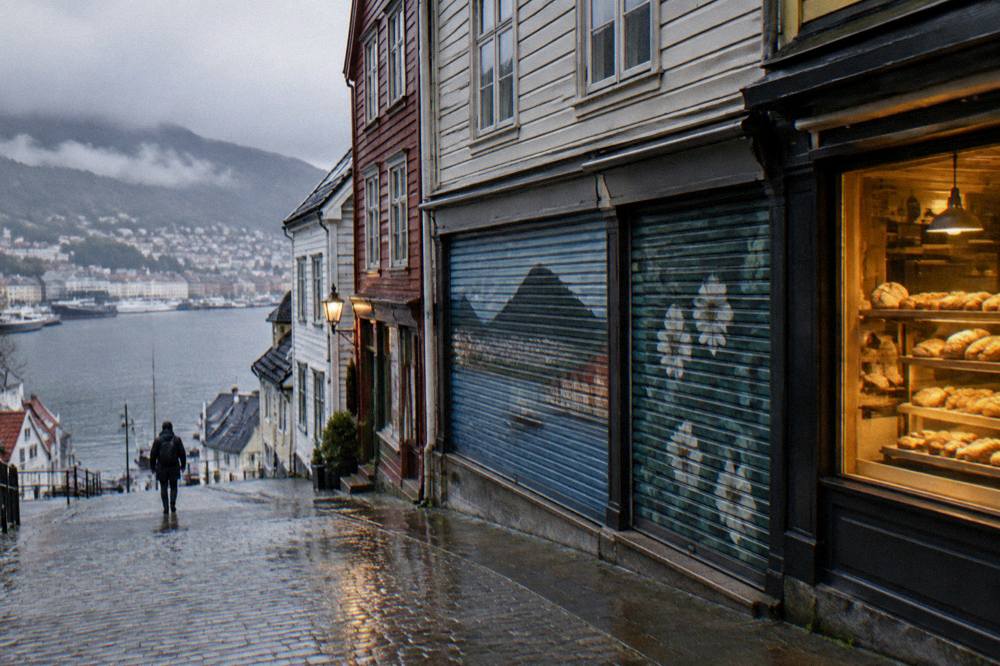
Winter deserves a word in its own defence, because it has one structural advantage: closed shops mean painted shutters are up all weekend. Combine that with the Christmas market window, 20 November to 22 December at Festplassen, and Pepperkakebyen, the gingerbread city, from 14 November 2026 to 10 January 2027, and a winter wall-walk turns into a full seasonal day. The cold is real but the table's January mean of -1.4C is milder than most of inland Norway.
For season-by-season trip planning beyond the walls, the best time to visit Bergen guide carries the full breakdown, and Bergen in winter handles the practical side of a cold-season visit.
What Does A Bergen Street-Art Day Cost To Plan?
The wall-hunting itself is free: every mural, paste-up and stencil is on public streets, so the only costs are transport and whatever sights you bolt on. A central walking day can be done for 0 NOK, a day that adds the funicular runs from 145 or 200 NOK depending on season, and a 24-hour Bergen Card at 400 NOK adult, 100 NOK child aged three to fifteen, covers Skyss buses, the Bybanen light rail including the airport line, and discounted entry to many attractions you pass.
The card math is the one decision worth making in advance, because the flyer prices are fixed and the arithmetic is simple. The card's transport coverage runs across all of Vestland county, not just the city:
| Bergen Card, 2026 | Adult | Child (3 to 15) |
|---|---|---|
| 24 hours | 400 NOK | 100 NOK |
| 48 hours | 500 NOK | 125 NOK |
| 72 hours | 600 NOK | 150 NOK |
| 96 hours | 700 NOK | 175 NOK |
The card includes free Skyss buses and Bybanen light rail across the county, including the airport line, which matters if your street-art day stretches beyond the walkable core. The Bergen Card guide carries the full inclusion list, and the how expensive is Bergen page puts the whole city in context if you are budgeting the trip rather than the day.
If your wall day expands into a fjord day, the scenic Hardangerfjord option below is the natural upgrade: it keeps the food-and-culture rhythm with lunch and waterfalls included, and the operator's live listing carries its current price and rating.
Common Questions About Bergen Street Art
Is Bergen street art free to see?
Yes, completely. Every mural, paste-up, sticker and stencil sits on public streets and surfaces, with no ticket, district or viewing fee. The only costs are the transport you choose and any paid attractions you add to the same walk; a purely central loop between the harbour, Marken and Skostredet needs no transport at all.
Where is street art in Bergen, Norway?
The productive zone is the compact central grid: the laneways behind the harbour front, the shopping quarter around Marken and Skostredet, and the streets climbing toward the Fløyen lower station. Beyond it, the Nordnes peninsula and the Sandviken slopes hold sparser, more weathered pieces among the timber houses. Everything is within walking distance of Bryggen.
What is the best time of day to see painted shutters in Bergen?
Early morning, late evening and Sundays, when shops are closed and their shutters are down. A painted shutter is hidden while the shop trades and revealed when it closes, so the same lane shows different walls at 8am than at noon. Late-afternoon light after a shower also flatters painted surfaces more than flat midday light.
Does Bergen's rain damage the street art?
Over time, yes. yr.no's Bergen station table shows 217 days with precipitation over the trailing 13 months, with November 2025 the wettest month at 321.8mm, and paint and paste-ups fade and peel accordingly. That is why the scene regenerates: expect a lane to look different between visits rather than the same mural waiting for you.
Can I combine Bergen street art with the main sights in one day?
Yes, and the geography does it for you. The harbour laneways sit directly behind Bryggen, the Marken quarter is a short walk from Torgallmenningen, and the Fløyen funicular's lower station is reached through the same central streets. A single day can cover the walls, Bryggen, one hill viewpoint and the Aquarium's Nordnes peninsula without a bus ticket.
Do any guided tours in Bergen include the street-art streets?
The central-lane walking tours, including the food-and-culture walks and the free, tip-based GuruWalk history strolls, cover the same streets where most of the paint concentrates, even though none of them is marketed as a street-art tour. A general city walk is therefore an efficient way to cover the wall-dense lanes with a local routing around dead spots. Check the operator's live listing for current times and prices.
The walls of Bergen will not be the reason you book the flight, but they are the layer of the city you get for nothing once you arrive, and they change often enough to reward the visitor who walks the same lane twice in one trip.