What Is The Rainiest Month In Bergen, Norway?
November is the rainiest month in Bergen, Norway by observed data, with December carrying the highest rainfall normal. Here is what Met Norway's station table actually shows, month by month.
Bergen, on Norway's southwestern coast in Vestland county, sees rain often enough that the question of which month is the wettest has a precise answer in the official record. The Norwegian Meteorological Institute (Met Norway) publishes a statistics table for its Bergen station, and that table shows November 2025 as the single wettest observed month in the trailing 13-month window, with 321.8mm of precipitation. December carries the highest normal, at 290mm. The distinction between what actually fell and what usually falls matters a lot here, and both numbers are worth understanding before booking anything.
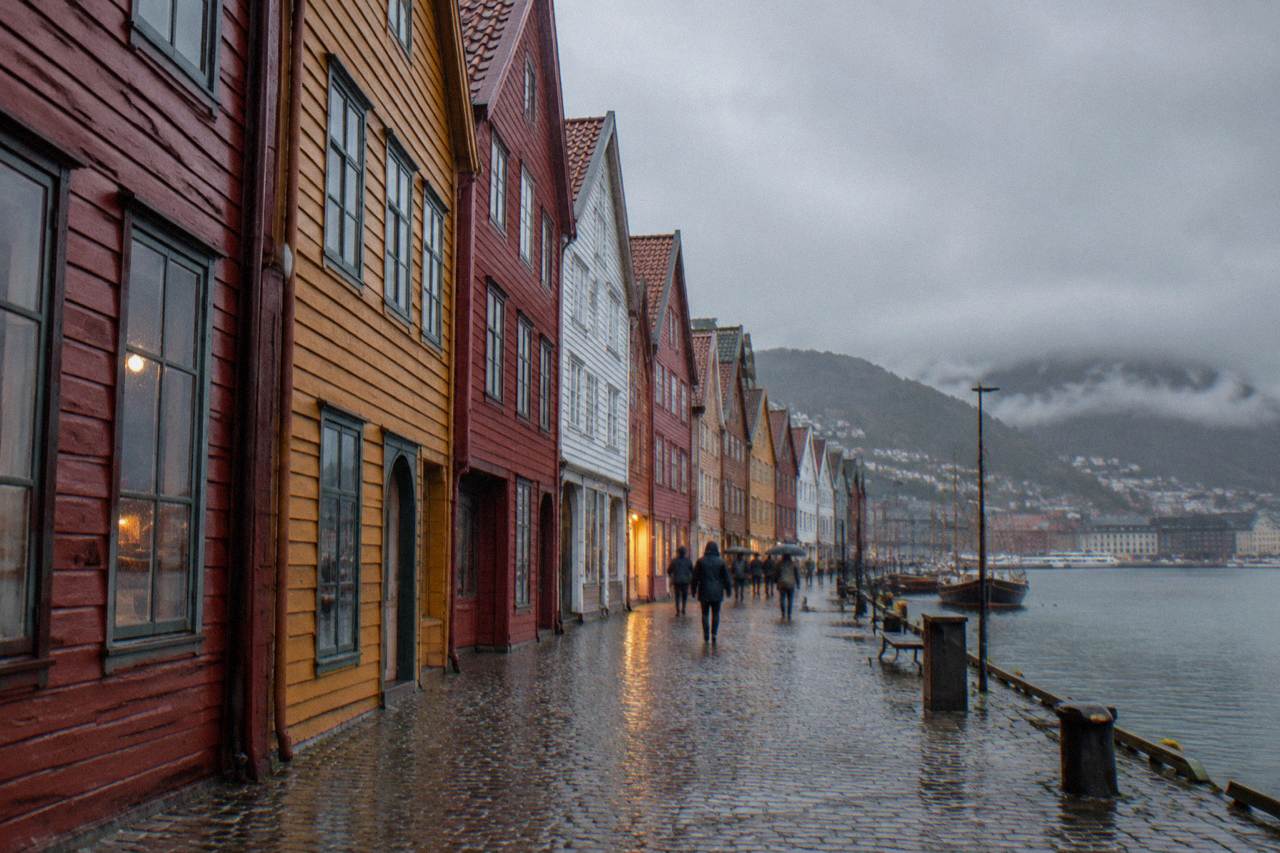
What Is The Rainiest Month In Bergen, Norway?
By observed data, November is the rainiest month in Bergen, Norway, with 321.8mm of precipitation recorded in November 2025, well above its own normal of 275mm. By long-term normal, December is the wettest month, carrying a normal of 290mm. The same Met Norway station table counts 217 days with precipitation across the trailing 13 months, which works out to measurable rain or snow on roughly three days out of every five.
The full monthly picture is below, drawn from the yr.no statistics table for the Bergen station. The observed column is what actually fell over the trailing 13 months; the normal column is the long-term reference Met Norway calculates for each month.
| Month | Observed precipitation (mm) | Precipitation normal (mm) | Mean observed temp |
|---|---|---|---|
| Aug | 165.1 | 208.0 | 15.1°C |
| Sep | 206.6 | 248.0 | 13.1°C |
| Oct | 231.9 | 268.0 | 9.7°C |
| Nov | 321.8 | 275.0 | 6.0°C |
| Dec | 303.5 | 290.0 | 5.8°C |
| Jan | 82.0 | 256.0 | -1.4°C |
| Feb | 133.4 | 209.0 | 0.8°C |
| Mar | 243.9 | 202.0 | 5.9°C |
| Apr | 65.9 | 141.0 | 7.9°C |
| May | 127.4 | 109.0 | 9.9°C |
| Jun | 165.7 | 132.0 | 14.4°C |
| Jul | 184.2 | 158.0 | 14.9°C |
Two things jump out of that table. First, November and December are consistently the peak of the wet season in both columns, which is why any visit in late autumn should be planned around covered activities. Second, individual months can swing far from their normals: January 2026 saw only 82mm against a normal of 256mm, while April 2026 came in at 65.9mm against a normal of 141mm. A single month's observation is a snapshot, not a forecast. If the goal is choosing a travel window, the normal column is the more reliable guide, and it points clearly at the November-through-January stretch as the wettest part of the year.
Bergen's rain has a lot to do with geography. The city sits between the coast and a wall of mountains, and moist North Atlantic air is forced upward as it meets the high ground, cooling and dumping its moisture on the way. That pattern repeats all along Norway's western coast, but Bergen's position at the head of a system of fjords and valleys makes it especially exposed. It also explains why the rain rarely arrives as a single clean front: showers roll in off the water, break against the mountains, and cycle again within hours.
How Much Rain Does Bergen Get In A Year?
Met Norway's trailing 13-month table for the Bergen station sums to 2,309.9mm of observed precipitation, which is more than two metres of water spread over the window. The monthly normals in the same table run from a low of 109mm in May to a high of 290mm in December, and 217 days out of the trailing 13 months registered measurable precipitation.
To put that in human terms, a place with 200 or more wet days a year is not a place where rain is an event. It is a place where rain is the default background condition, and clear skies are the interruption. That has practical consequences for how the city works: umbrella stands outside shops, covered walkways in the busy parts of the centre, and a whole culture of hiking through it anyway. Norwegians have a word for the attitude, and Bergen residents practice it daily.
The seasonal shape of the data is worth reading carefully. The wettest normals stack up in October, November and December (268mm, 275mm and 290mm respectively), then fall through spring. May's normal of 109mm is the driest slot in the whole table, which is why May is often recommended as a shoulder-season pick: prices are lower than midsummer, the coast is greening up, and the odds of a dry day are at their best. June and July normals sit at 132mm and 158mm, still wet by most European standards, but far more manageable than deep autumn.

There is a planning lesson in the temperature column as well. November's observed mean of 6.0°C and December's 5.8°C mean the wettest months are also dark, chilly ones. July's 14.9°C mean, by contrast, comes with long evenings and a real chance of rain that fades rather than settles. Anyone weighing a visit should read the month-by-month detail on the best time to visit Bergen alongside these rainfall numbers, since temperature and daylight change the experience as much as the precipitation does.
Does It Rain Every Day In Bergen, Norway?
No, it does not rain every day in Bergen, but 217 of the trailing 13 months' days registered precipitation, so the odds of encountering rain on any given day are close to three in five. The rain also tends to come in showers rather than unbroken downpours, and a wet morning frequently gives way to a dry afternoon in this coastal climate.
The distinction matters for planning. A visitor who sees "217 days with precipitation" often pictures a city under permanent grey, but the statistic counts any day with measurable precipitation, including a ten-minute shower and including days where snow fell instead of rain. January 2026, for instance, recorded a mean of -1.4°C and a low extreme of -11.3°C in the trailing window, which means some of that winter precipitation arrived as snow rather than rain. Met Norway's table does not publish a per-month breakdown of rain days, so any claim of an exact figure per month would be invented, and this page will not make one.
The practical version of the answer is this: pack for rain, expect some rain, and do not cancel anything because of it. Locals do not reorganize their lives around the forecast. Trails up Fløyen and Ulriken are used year-round in boots and shells, the fish market's outdoor stalls sit under cover, and the museums fill exactly as they would on a clear day. The city's indoor layer, from the Hanseatic Museum to the KODE galleries, is extensive enough that a wet stretch of days can be spent entirely well.
A wet forecast is also not a reason to skip the fjord experiences. Zodiac and RIB operators run in the rain, and the fjord scenery often looks more dramatic in low cloud and drizzle than under a flat blue sky.
Which Months Are The Driest In Bergen, Norway?
By normal, May is the driest month in Bergen, Norway at 109mm, followed by July at 158mm and June at 132mm. In the observed trailing 13 months, the driest month was April at 65.9mm, with January at 82.0mm a surprise second, both well under their own normals of 141mm and 256mm.
The observed column's driest entries are a useful caution against over-reading a single year. January 2026 happened to be unusually dry in Bergen while still being cold, with that -1.4°C mean, and April 2026 landed at less than half its normal precipitation. Neither of those observations changes the long-term picture, which still puts May, June and July at the comfortable end of the scale. For travellers, the reliable pattern is simple: the driest normals cluster from late spring through midsummer, and the wettest cluster from October through December.
The shoulder seasons split the difference. September's normal of 248mm makes it genuinely autumnal, while June's 132mm combined with a 14.4°C mean makes it one of the friendliest months in the table. Anyone trying to dodge peak crowds while keeping reasonable weather could look at June, or the June festival window: the same stretch of the calendar brings the Bergen International Festival (27 May to 10 June 2026), Bergenfest (10 to 13 June 2026) and Nattjazz (29 May to 6 June 2026) into the city at once. More on the wider calendar, including what each season does to the rainfall odds, is covered in what is the best month to visit Norway fjords.
One further note on January: it is the coldest month as well as a sometimes-dry one, and the two facts are related. Cold air holds less moisture, and when the winter pattern sets in with clear inland air pushing toward the coast, Bergen can get bright, frozen, comparatively dry weeks. Those weeks are the exception, not the rule. The month-by-month detail is in what is the coldest month in Bergen, Norway.
Is Rain A Reason To Avoid Bergen?
No, rain is not a reason to skip Bergen: the city's main attractions, from the Hanseatic wharf at Bryggen to its museums and covered market areas, are fully usable in wet weather, and 217 wet days out of 13 months has not stopped Bergen from becoming one of Norway's most visited cities. The workable strategy is to schedule flexible outdoor plans for mornings and hold indoor options in reserve.
The indoor reserve is genuinely deep. The city centre holds a cluster of museums within a short walk of each other, the aquarium runs year-round, and the food scene is built for sheltering in place. A food and culture walk through the market and eating streets is one of the better rainy-day formats, since it moves between covered and indoor stops with a guide who can shift the route as the weather shifts.
It is also worth knowing what the rain does to the scenery before writing it off. Low cloud on the mountains around the city, mist in the fjord valleys, and wet cobblestones reflecting the lights of Bryggen at dusk are the conditions that give Bergen its most photographed look. Photographers actively chase the aftermath of rain here. The city's reputation as the rainiest in Europe is examined in detail in is Bergen the rainiest city in Europe, and the answer there is more nuanced than the nickname suggests.
For travellers weighing Bergen against other Norwegian cities, the rain variable is real but manageable. The trade-offs, including how the western coast compares with the drier east around the capital, are laid out in which is nicer, Oslo or Bergen. Anyone still unsure whether the city justifies the trip can start from what is so special about Bergen, Norway, which covers the UNESCO-listed wharf, the Hanseatic history and the fjord access that draw visitors regardless of the forecast.
Common Questions About Rain In Bergen
What is the rainiest month in Bergen, Norway?
By observed data, November is the rainiest month in Bergen, with 321.8mm recorded in November 2025 against a normal of 275mm. By long-term normal, December is the wettest month at 290mm. Both months sit at the peak of Bergen's wet season, which runs roughly from October through December.
How many days a year does it rain in Bergen?
The trailing 13 months from Met Norway's Bergen station table counted 217 days with precipitation, roughly three days in five. That count includes days with only brief showers and days when precipitation fell as snow, so it does not mean constant rain.
Does Bergen get more rain than other European cities?
Bergen is among the wettest cities in Europe. Its trailing 13-month observed total of 2,309.9mm comes from a coastal position between the North Atlantic and a wall of mountains, which forces moist air upward and wrings it out over the city.
What is the driest month in Bergen?
By normal, May is the driest month at 109mm, with June at 132mm and July at 158mm close behind. In the observed trailing window, April was the driest month at 65.9mm, though that reflects an unusually dry spell rather than the long-term pattern.
Is the rain in Bergen constant or does it come in showers?
Bergen's rain mostly arrives in showers and passing fronts rather than unbroken downpours, and wet mornings often turn into dry afternoons. The city's temperate oceanic climate cycles quickly, which is why locals treat the forecast as background information rather than a plan.
Should I still visit Bergen during the rainy season?
Yes. The museums, aquarium, covered market areas and restaurants all operate normally in wet weather, and the fjord and harbour tours run in the rain. Late autumn also brings the Christmas season, with the Bergen Christmas market at Festplassen running from 20 November to 22 December 2026 and the Pepperkakebyen gingerbread city from 14 November 2026 to 10 January 2027.
Bergen Travel Guide keeps the Bergen Travel Guide home page updated with season-by-season planning notes, so the rainfall picture above can be paired with the right itinerary for whatever month the trip lands in.