Is Bergen The Rainiest City In Europe?
Bergen, Norway is famous for rain, but is it really the rainiest city in Europe? Verified Met Norway data explains what the numbers actually show.
Bergen, a former Hanseatic League trading post on the southwestern coast of Norway in Vestland county, has spent decades carrying the label "the rainiest city in Europe." The reputation is not invented: yr.no's Bergen station table, which carries Norwegian Meteorological Institute data, records 217 days with precipitation over the trailing 13 months, and a single November dumped 321.8 mm of rain on the city. But "rainiest" is a slippery word, and the crown changes hands depending on whether you count days of rain, total millimetres, or hours of drizzle. This page looks at what the verified numbers actually say, why the coast of Vestland is so wet, and what a rainy reputation means for a visit, using only figures from Met Norway's own station table and the official Bergen Card flyer.
Is Bergen The Rainiest City In Europe?
No single authority crowns a "rainiest city in Europe," and Met Norway's Bergen station data supports "one of the rainiest" rather than an uncontested first place: 217 days with precipitation over the trailing 13 months, and monthly totals swinging from 65.9 mm in April 2026 to 321.8 mm in November 2025. The ranking depends entirely on the yardstick, and other European cities contest the title depending on whether the comparison uses rainy days, annual millimetres, or drizzle hours.
The claim circulates in two forms. The strong version says no European city gets more rain than Bergen, full stop. The weaker and more defensible version says few European cities combine Bergen's frequency of wet days with its volume of rainfall, and that the city's own residents have turned the weather into a running joke, complete with souvenir umbrellas and rain-themed merchandise in shop windows along Bryggen.
What makes the strong version hard to prove is that Europe has no single official league table. National meteorological services publish their own station data on their own schedules, and mountain towns in the Alps, the Scottish Highlands, the Norwegian fjord country and the Balkans all record enormous totals at specific stations. A city-centre station like Bergen's answers a different question than a rain-gauge perched on a windward slope. yr.no's table for the Bergen station is a first-class primary source for Bergen itself; it says nothing about anywhere else, and this page will not dress it up as a ranking it cannot support.
What can be said with confidence is directional. Bergen's climate is temperate oceanic, wetter than most of Norway, with 217 wet days in the trailing 13 months according to yr.no's station table. That frequency, not any single record-shattering month, is what built the reputation. For a month-by-month breakdown of the wettest stretches, see the rainiest month in Bergen.
How Much Rain Does Bergen Actually Get?
The verified Met Norway data for the Bergen station shows observed monthly precipitation ranging from 65.9 mm in April 2026 up to 321.8 mm in November 2025, with December 2025 adding 303.5 mm of its own, and 217 days with precipitation across the trailing 13 months, which means the city averages rain on more days than not rather than a few dramatic downpours a year.
The table below is drawn directly from yr.no's Bergen station statistics, which carry Norwegian Meteorological Institute observations for the trailing 13 months. Note the gap between observed values and long-run normals: some months came in far above the normal, others below it, which is why no honest summary squeezes this record into one "annual average" number.
| Month | Observed mean temp | Precipitation observed (mm) | Precipitation normal (mm) |
|---|---|---|---|
| Sep 2025 | 13.1° | 206.6 | 248.0 |
| Oct 2025 | 9.7° | 231.9 | 268.0 |
| Nov 2025 | 6.0° | 321.8 | 275.0 |
| Dec 2025 | 5.8° | 303.5 | 290.0 |
| Jan 2026 | -1.4° | 82.0 | 256.0 |
| Feb 2026 | 0.8° | 133.4 | 209.0 |
| Mar 2026 | 5.9° | 243.9 | 202.0 |
| Apr 2026 | 7.9° | 65.9 | 141.0 |
| May 2026 | 9.9° | 127.4 | 109.0 |
| Jun 2026 | 14.4° | 165.7 | 132.0 |
| Jul 2026 | 14.9° | 184.2 | 158.0 |
| Aug 2026 | 14.3° | 243.6 | 208.0 |
Two details in that table surprise first-time visitors. First, autumn is the soaking season: November 2025 alone delivered 321.8 mm at the station and December followed with 303.5 mm, while spring can be comparatively dry, as April 2026's 65.9 mm shows. Second, the temperature range is narrow for a city this far north on the Atlantic coast, from -1.4° in January to 14.9° in July over the observed period, with extremes of 28.0° and -11.3° recorded in the same 13 months. The ocean moderates both ends. What the ocean does not moderate is the water.
The frequency figure is the one to remember when packing. The trailing-13-month count of 217 days with precipitation is the live figure from the same yr.no table; older references of roughly 196 to 200 days a year also circulate, and the honest reading is that somewhere in that region of frequency is the working baseline, with the current live figure at the higher end. Either way, the practical conclusion is the same: waterproof layers beat an umbrella in wind, and a hood beats both.
Why Is The Bergen Climate So Wet?
Bergen sits on a coast where moist North Atlantic air is forced upward by the mountains that wrap the city on three sides, and that combination of sea-warmed airflow and terrain produces frequent, persistent precipitation, which is why the wettest months cluster in autumn and early winter when Atlantic low-pressure systems track closest to the Norwegian coast and the temperature contrast between sea and land is at its sharpest.
The mechanism is orographic lift, and it is the reason the whole Vestland coast, not just Bergen, is damp. Air picking up moisture over the North Sea hits the mountains of western Norway and has nowhere to go but up. Rising air cools, the water vapour it carries condenses, and the rain falls on whoever is standing below, which is usually Bergen. The city's famous seven mountains are not just a postcard flourish; they are the machinery of the rainfall. More of these guides are collected on Bergen Travel Guide.
The same geography explains the mildness. The North Atlantic current keeps the coast warmer than the latitude suggests, which is why a January mean of -1.4° at the station, cold enough for the curious to note, is nothing like the deep freezes of inland Norway at the same latitude. Rain rather than snow is the default in the city centre for most of the winter, though the surrounding summits whiten early. The verified extremes over the trailing 13 months, a high of 28.0° on 14 August and a low of -11.3° on 8 January, bracket a climate that is oceanic through and through.
This is also why forecasts matter more here than in most cities. The same mountain-and-sea machinery that makes rain frequent also makes it changeable: a morning of steady drizzle can give way to a bright afternoon, and the reverse. Locals plan around it rather than against it, which is a habit worth borrowing. For a broader look at what else the weather shapes, see what is so special about Bergen, Norway.
Rain also changes what a visit looks like, and not always for the worse. Museums and covered markets carry the wet days, and several of the city's headline indoor sights are priced in the official 2026 Bergen Card flyer, which makes a comparison straightforward. The table below collects the verified line items.
| Attraction or service | Verified price (official 2026 Bergen Card flyer or operator page) |
|---|---|
| Bergen Card, 24h, adult / child 3-15 | NOK 400 / 100 |
| Bergen Card, 48h, adult / child | NOK 500 / 125 |
| Fløibanen funicular return, adult (Apr-Sep) | NOK 200 |
| Fløibanen funicular return, adult (Oct-Mar) | NOK 145 |
| Ulriken643 cable car return, adult | NOK 435 |
| Hanseatic Museum, with guided visit | NOK 160 |
| Bryggen Museum, ordinary / with Bergen Card | NOK 170 / 85 |
| Haakon's Hall | NOK 120 |
| The Aquarium, adult (Nov-Feb window) | NOK 380 |
Does The Rain Ruin A Visit To Bergen?
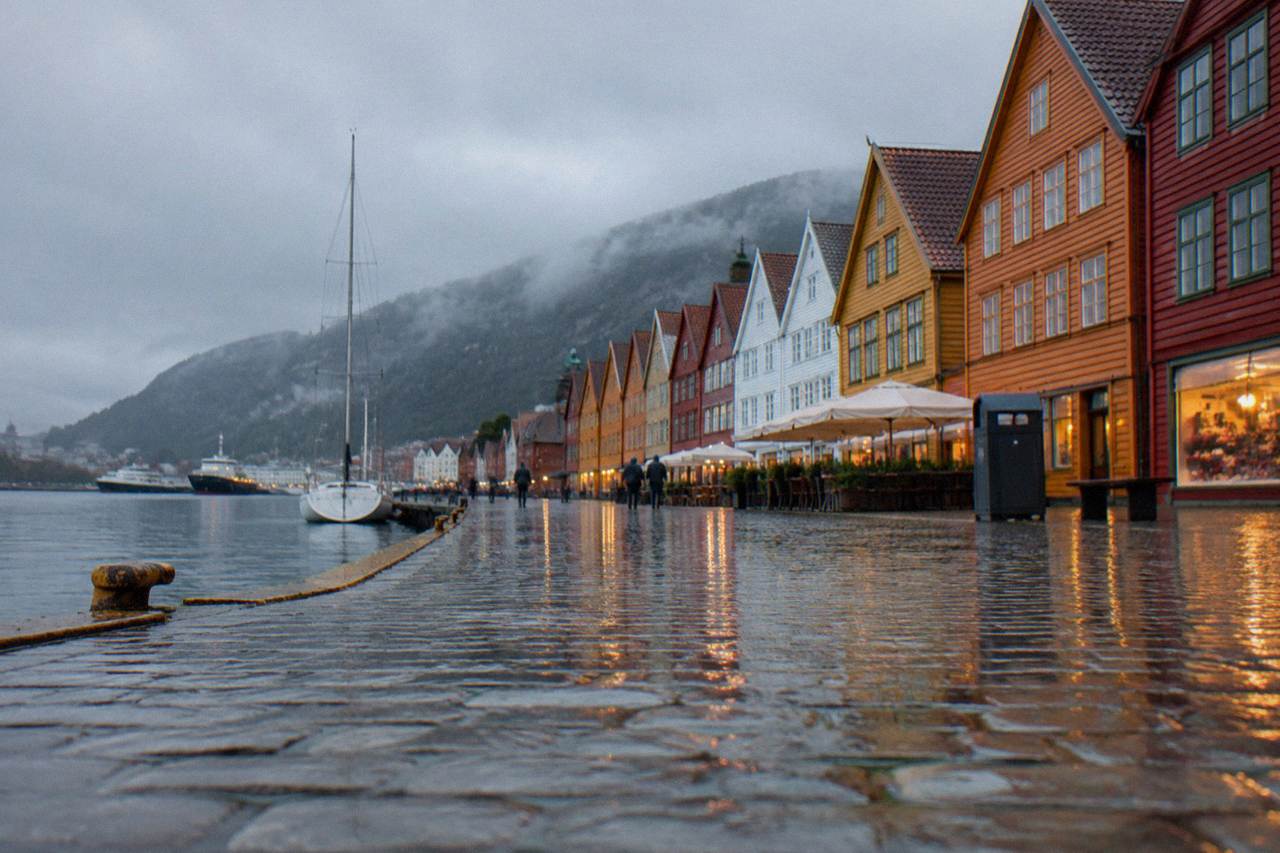
It does not, and in practice the rain is part of what the city is: the wet streets reflecting the lights of Bryggen's Hanseatic wharf, a UNESCO World Heritage site inscribed in 1979, are a signature image precisely because of the weather, and the city's food halls, museums, cafés and covered walkways give visitors a full day of things to do even when the rain sets in for hours.
The food scene is the most rain-proof part of a Bergen day. The Food and Culture Walk keeps the group largely under cover and indoors between stops, moving between the fish market's counters, bakery benches and shopfronts where the conversation turns to what the coast has always eaten: stockfish, brown cheese, cinnamon buns and whatever the boats brought in that morning. It is also the natural pairing for a wet afternoon, since eating is the one activity that rain improves. Check availability if that sounds like the right pace for your group.
Beyond food, the indoor roster is deep enough to fill two soggy days: the museums of the harbour edge, the Hanseatic Museum's timber rooms, the Aquarium on the Nordnes tip, and the KODE art museums on the lake, whose 200 NOK line item in the Bergen Card flyer covers the bundled admission window. None of this requires luck with the sky. And when the clouds do lift, the payoff is immediate: the mountains ring the harbour so tightly that clearing weather turns a grey ten minutes into a full panorama within the hour.
The honest framing for a prospective visitor is that Bergen trades guaranteed sunshine for drama. On the question of whether the city is still worth the trip despite the forecast, is Bergen worth visiting covers the fuller argument, wet days included.
What Should You Pack For Bergen Weather?
Pack for frequent light-to-moderate rain rather than rare downpours: a waterproof shell with a hood, waterproof shoes or boots with real grip for wet cobblestones and steep lanes, quick-dry layers rather than heavy insulation, and a small umbrella as a backup only, since harbour wind makes umbrellas a losing proposition and the locals mostly wear hoods and get on with it.
The word "layers" is doing the work in that answer, and it is worth unpacking. The verified temperature spread over the trailing 13 months runs from a mean of -1.4° in January to 14.9° in July, with recorded extremes of 28.0° and -11.3°. A summer visitor may meet a warm, still afternoon; the same visitor should still carry the shell, because the same trailing period shows August 2026 alone taking 243.6 mm at the station. A winter visitor needs warmth that survives damp, which is a different requirement from dry cold: wool and synthetic insulation keep working when the drizzle finds them, while cotton does not.
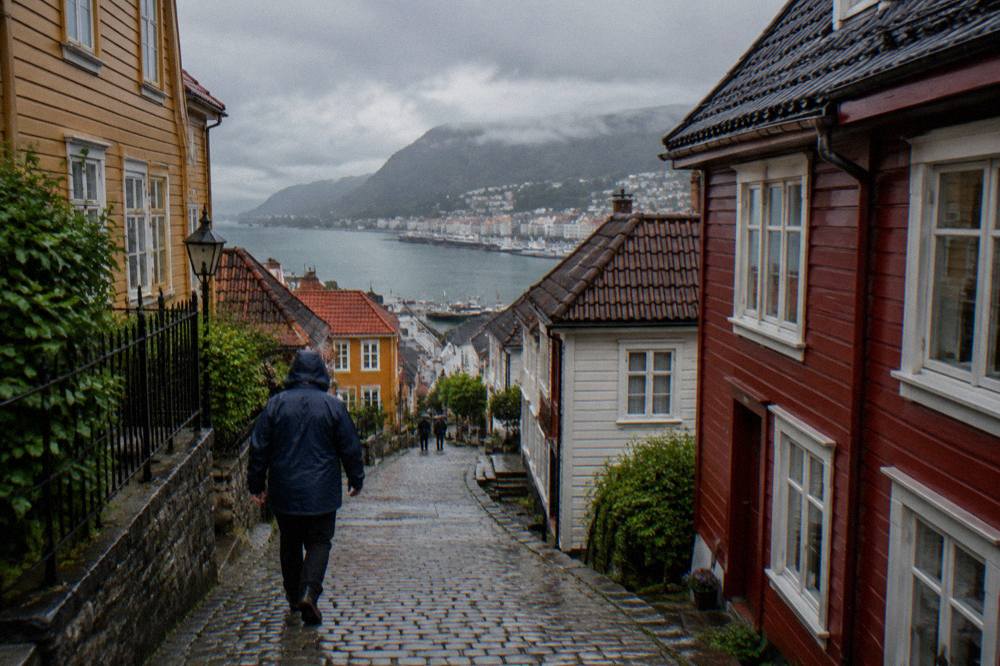
Footwear deserves its own sentence. Bergen's lanes are steep, its stones are old, and its surfaces are wet more days than not on the current live count. Grip matters more than style here, more even than in most Norwegian cities, because the rainiest walking routes are also the most photogenic ones, from the Fløibanen's upper station paths down to the wooden houses of Sandviken.
The city's own response to the weather is practical rather than defeatist, and it is worth copying wholesale. Nobody waits for a dry Saturday. Cafés put blankets on outdoor seats, the fish market keeps its counters under cover, and the Bergen Card's bundled transport, free Skyss buses and the Bybanen light rail across Vestland county including the airport line, means the wet walk from A to B is often optional. The card's own flyer lists all of this, and it is the single strongest argument that the rain was never a reason to stay home.
Common Questions About Rain In Bergen
Is Bergen the rainiest city in Europe?
No verified ranking crowns a single rainiest city in Europe, and Bergen's own Met Norway data supports "one of the rainiest" rather than an uncontested first place, with 217 days with precipitation over the trailing 13 months and a November that delivered 321.8 mm at the city station.
How many days a year does it rain in Bergen?
yr.no's Bergen station table shows 217 days with precipitation over the trailing 13 months; older references cite roughly 196 to 200 days a year, so a working baseline of frequent, often light rain on more days than not is the honest reading.
What is the wettest month in Bergen?
In the trailing 13 months, November was the wettest observed month at 321.8 mm, with December close behind at 303.5 mm; the long-run normal also peaks in late autumn, as the rainiest month breakdown explains in detail.
Does it snow in Bergen in winter?
Rain is the default in the city centre through most of the winter, because the oceanic climate keeps January's observed mean at -1.4°, though the surrounding mountains whiten early and the station recorded a low of -11.3° in January, so snow happens, but it rarely stays for long at sea level.
Is Bergen still worth visiting given the rain?
Yes: the same wet climate that built the reputation also keeps the harbour green, the food culture strong and the museums busy, and the city's covered market halls, museums and food-focused walks give a full itinerary even on the wettest days.
The short version is that Bergen, Norway is wet by almost any measure, wet on a frequency that reshapes how you pack and how you plan, and still one of the most rewarding cities on the Norwegian coast, umbrella optional, hood recommended.