What Food Is Bergen Famous For?
Bergen, Norway, is famous for its harbour fish market, seafood soups, cinnamon buns and a winter gingerbread tradition. Here is what to eat and when.
Bergen, a former Hanseatic League trading post in Vestland county on Norway's southwestern coast, is famous for what the North Sea and the fjords put on the table. The city grew rich trading dried fish across the north Atlantic, and it still eats the way it earned its money: fresh cod, saithe and salmon sold off the ice at the harbour fish market, and a thick, creamy fiskesuppe built on the same catch. Layered over that is a café culture of skillingsboller cinnamon buns and waffles with brown cheese, plus one of the more surprising festive traditions in Scandinavia, a gingerbread city assembled every winter. This Bergen Travel Guide page breaks the city's food fame into its parts: what the signature dishes are, where the seafood tradition comes from, which tours and festivals put it in front of you, and how to build a food day on foot.
What Food Is Bergen Famous For?
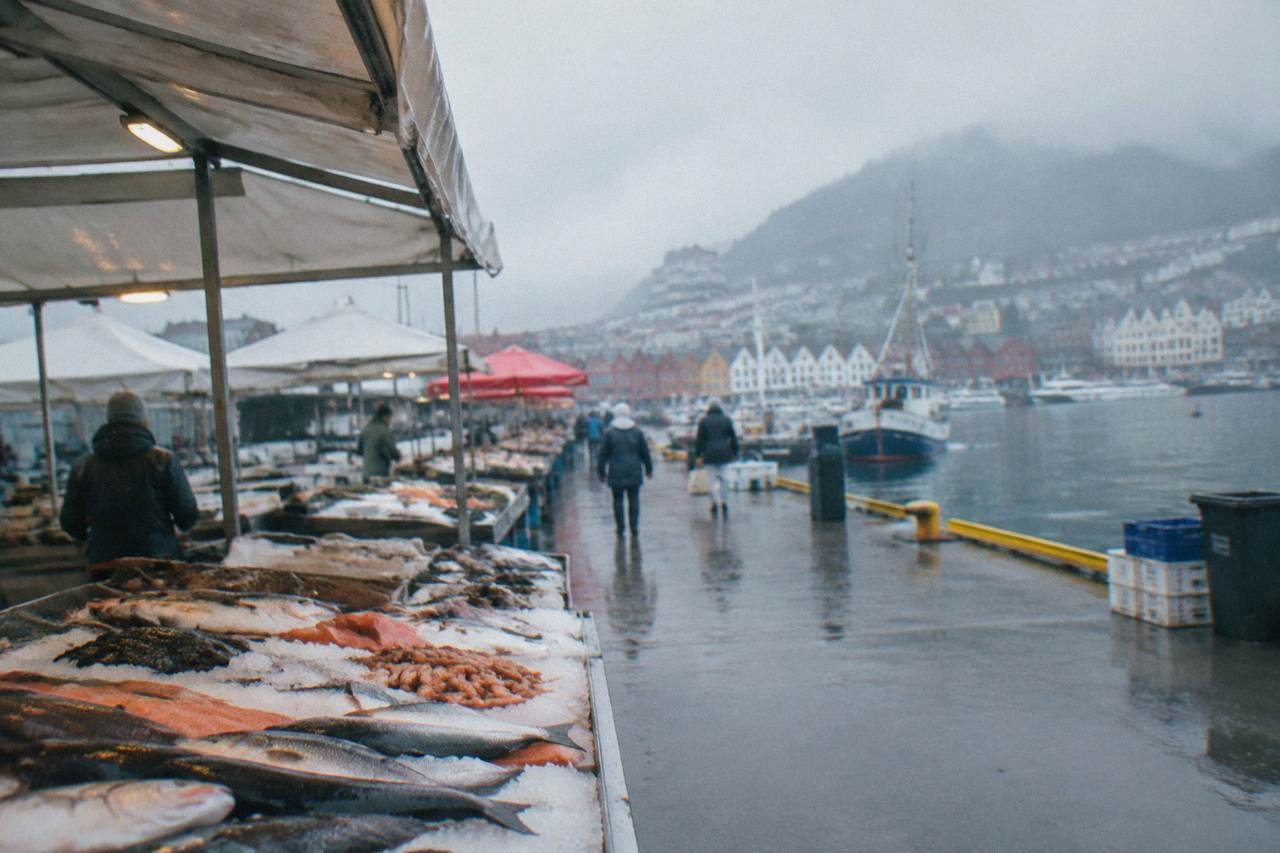
Bergen, in Vestland county on Norway's southwestern coast, is famous for cold-water seafood: fresh cod, saithe and salmon sold daily at the open-air fish market on the harbour, and the creamy fiskesuppe fish soup built on that same catch. Around the seafood sits a bakery culture of skillingsboller cinnamon buns and heart-shaped waffles served with brown cheese, and each winter the city assembles Pepperkakebyen, a gingerbread city billed as the world's largest.
The fish market is the anchor. It sits on the inner harbour, within sight of the coloured wooden buildings of Bryggen, and it is one of the few tourist sights in the city that is genuinely a working market rather than a museum piece. Vendors sell off the ice, cook to order, and mostly expect you to eat standing up or on a bench facing the water. On a wet day, and Bergen has 217 days with precipitation in the trailing 13 months of Met Norway records, that bench may come with an umbrella.
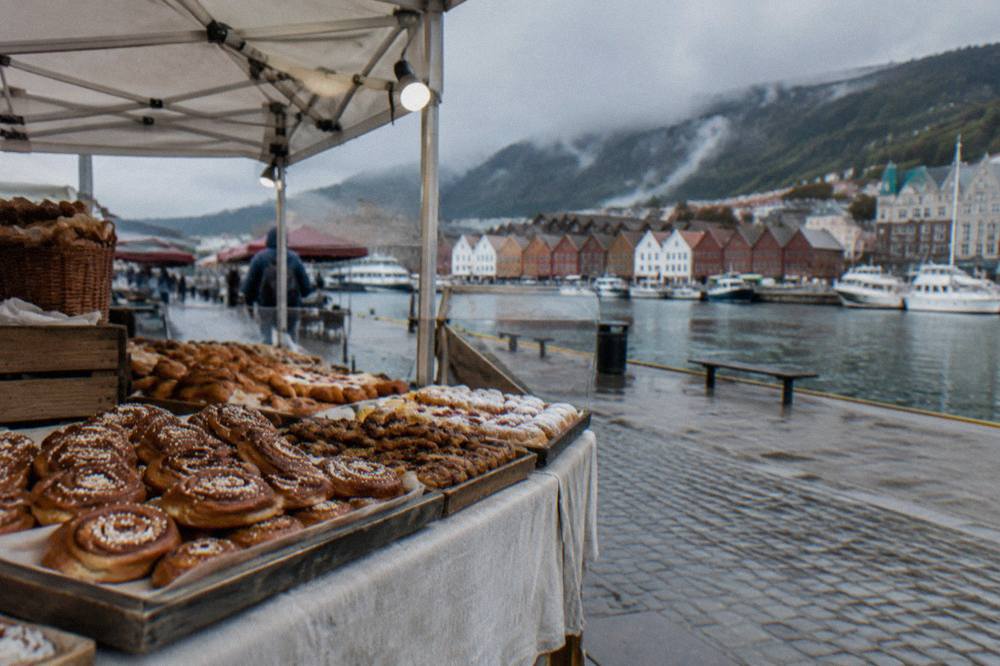
The bakery layer is easy to miss if you only follow the fish. Norwegian café culture is strong in Bergen, and the skillingsbolle, a cardamom-spiced cinnamon bun, is its everyday currency. Waffles with brunost, the sweet caramel-flavoured brown cheese, are the other constant, served in cafés and mountain stations alike. None of this is hidden; it is simply that the talk of fjords tends to give way to memories of the food.
| Food | What it is | Where it sits in Bergen's food life |
|---|---|---|
| Fiskesuppe | Creamy fish soup, typically with mixed daily catch | A harbour restaurant standard, built on fish-market supply |
| Fresh cod and saithe | Whole fish and fillets sold off the ice | The open-air fish market on the inner harbour |
| Salmon | Cold-water salmon, cured and fresh | Fish market counters and restaurant menus across the centre |
| Skillingsboller | Cardamom-spiced cinnamon buns | Bakeries and cafés citywide, eaten year-round |
| Waffles with brunost | Heart-shaped waffles with brown cheese | Cafés, mountain stations and the Christmas market |
| Pepperkakebyen gingerbread | A seasonal gingerbread city display | A winter attraction, open mid-November to early January |
Where Does Bergen's Seafood Tradition Come From?
Bergen's seafood tradition grew out of the dried-fish trade that the Hanseatic League ran from the wharf at Bryggen, when the city was a German trading post and salted, dried cod was a currency of the north Atlantic. Bryggen has been on the UNESCO World Heritage List since 1979, and the fish market and the Hanseatic Museum still sit within a short walk of the old wharf.
The Hanseatic merchants who controlled trade from Bryggen for centuries shipped dried and salted fish out of Bergen and brought grain, cloth and salt back in. That single trade route explains the city's food character: a population surrounded by first-class protein, organised around a wharf, and used to preserving and curing rather than wasting. The habits outlived the merchants. The Hanseatic wharf at Bryggen is the biggest single attraction in the city, and the food culture around it still leans on the harbour.
What that history means for a visitor today is that Bergen's food is best understood by walking it rather than reading menus. The distances involved are small. The fish market, the wharf lanes, the small specialist food shops and the seafood restaurants cluster inside the compact centre, which is why the city's guided food walks can cover so much ground in a single outing. The deeper background is covered in Bergen's dedicated food tours guide, which compares the walking and tasting options in one place.
The seafood itself has not changed much in character, only in presentation. What was once stockfish stacked for export is now salmon cured in a harbourside kitchen, and what was a trader's quick lunch is now a bowl of fiskesuppe in a restaurant facing the same water. The continuity is the point: this is a city whose most famous food is the one it has always had.
Which Bergen Food Tours Show You The City Through Its Food?
Bergen's food tours are the fastest way to eat the city well: the Taste of Bergen food tour pairs food stops with a ride up the Fløibanen funicular, while a separate food and culture walk works central Bergen on foot, both with local guides who explain the Hanseatic background as they feed you. Prices and current ratings for both are shown on each operator's live listing rather than published here.
The funicular pairing matters more than it sounds. Fløibanen climbs from the centre to the top of Fløyen, and a return ticket costs 200 NOK for an adult from 1 April to 30 September, or 145 NOK from 1 October to 31 March, per the official 2026 Bergen Card price table. A tour that folds the ride into its route gives you the city's two halves, the eating streets below and the viewpoint above, without a separate ticket decision.
The walking-only alternative suits anyone who would rather spend the whole outing at street level. It moves through the same central lanes with tastings built into the route, and it is the better fit on a day when the mountain is buried in cloud, which in this city is a real planning consideration.
Two practical notes before booking. First, the touring side of Bergen's food scene is genuinely seasonal: the Christmas period adds market stalls and the gingerbread city to the standard route, and guides adapt their stops around what is open. Second, deciding how many days in Bergen is enough shapes which tour you pick, because a one-day visitor usually wants the compressed version and a three-day visitor can afford the slower one.
A food tour also answers the question every visitor eventually asks: where do the people who live here actually eat. Guides are locals, and their route is generally a map of that answer, weighted toward the places that survive when the cruise crowds thin out.
When Do Bergen's Food Festivals And Markets Happen?
Bergen's food calendar concentrates in autumn and winter: the Bergen Matfestival food festival runs around 4-5 September 2026 alongside the Norsk Siderfestival cider festival, the Christmas market at Festplassen runs 20 November to 22 December 2026 with free entry, and Pepperkakebyen, the gingerbread city, is open 14 November 2026 to 10 January 2027. Spring and summer belong instead to the everyday harbour fish market.
The September festival is the one serious eaters should aim for. It takes over central venues with producer stalls, tastings and the cider festival running beside it, and it lands in early autumn when the city is past its peak visitor rush but still fully open. The Christmas period is the second window, and it is the more atmospheric of the two: Festplassen fills with market stalls, and free entry means you can wander in repeatedly rather than rationing a single visit.
The gingerbread city deserves its own paragraph. Pepperkakebyen is a display assembled from gingerbread contributions, largely built by local children and community groups, and the visitbergen.com listings carry it as a headline winter attraction, open 14 November 2026 to 10 January 2027. For a food-famous city, it is the moment the food turns into architecture.
| Event | Dates | Venue and access |
|---|---|---|
| Bergen Matfestival with Norsk Siderfestival | Around 4-5 September 2026 | Central Bergen venues |
| Bergen Christmas Market | 20 November to 22 December 2026 | Festplassen, free entry, 12:00-21:00 weekdays and 10:00-21:00 weekends |
| Pepperkakebyen gingerbread city | 14 November 2026 to 10 January 2027 | City centre display, billed as the world's largest gingerbread city |
How Do You Build A Food Day Around Bergen's Fish Market?
A food day in Bergen works best anchored on the harbour fish market, worked outward through Bryggen's lanes for bakery stops, and finished from the top of Fløyen, where the funicular's upper station looks back over the city and the fjord. The market, the wharf and the funicular's lower station all sit inside the compact centre, so the whole day can be done on foot.
Start early at the fish market, while the ice displays are fresh and the benches facing the harbour are still free. Eat something cooked to order rather than pre-wrapped, then loop through the Bryggen lanes behind the wharf, where the small shops and cafés carry the bakery side of the city's food fame. The skillingsboller stop belongs somewhere in this stretch, ideally with a coffee.
The afternoon splits depending on weather. Clear, take the Fløyen side and earn the view with a waffle at the top. Wet, which is statistically the likelier case, stay low and trade the mountain for the museums, since judging whether Bergen is worth visiting in the rain usually comes down to how well you use the indoor half of the city. Either way the evening should return you to the harbour for a proper restaurant dinner, with fiskesuppe as the safest order in the house.
Budget one note of realism. Norway's currency is the krone (NOK), and eating out in Bergen is priced accordingly, so a food day built around the market, a bakery and one restaurant dinner is a more sensible shape than three sit-down meals. The market's cooked-to-order counters are the flexible middle: cheaper than a restaurant, more substantial than a café.
Common Questions About Bergen Food
What food is Bergen famous for?
Bergen is famous for cold-water seafood, above all the fresh cod, saithe and salmon sold at the harbour fish market and the creamy fiskesuppe fish soup built on that catch, plus a bakery culture of skillingsboller cinnamon buns and waffles with brown cheese, and a large seasonal gingerbread display each winter.
What is fiskesuppe?
Fiskesuppe is Bergen's signature fish soup, a rich, creamy soup made with mixed fish and shellfish from the daily catch. It appears on harbour restaurant menus year-round and is the standard order for a first dinner in the city.
Where should you eat seafood in Bergen?
The open-air fish market on the inner harbour is the classic spot for fresh fish cooked to order, and the seafood restaurants facing the same water carry the sit-down version. Both sit within a short walk of Bryggen.
What is a skillingsbolle?
A skillingsbolle is a Norwegian cinnamon bun spiced with cardamom, sold in bakeries and cafés across Bergen. It is the everyday staple of the city's café culture and pairs with coffee rather than a meal.
Is food in Bergen expensive?
Eating out in Bergen is priced in Norwegian kroner at typical Norwegian levels, so restaurant meals feel high compared with much of Europe. A practical food day uses the market counters and bakeries for the daytime and puts the budget into one proper dinner.
When is the Bergen Christmas market open?
The Bergen Christmas market at Festplassen runs 20 November to 22 December 2026, with free entry and opening hours of 12:00-21:00 on weekdays and 10:00-21:00 at weekends.