How Do Norwegians Say Bergen?
How Norwegians pronounce Bergen, what the city's name means, why the local dialect sounds different, and how to say the landmark names around Norway's western fjord capital.
Bergen, the Hanseatic trading city in Vestland county on Norway's southwestern coast, has a name that almost every English speaker mispronounces on arrival. The spelling suggests BER-gen or bur-GEN, and neither is what leaves the mouths of the roughly 294,860 residents the kommune's own statistics page records as of 1 January 2026. The difference between the written name and the spoken one is small, but it is the kind of detail that changes how a waiter, a ticket clerk or a taxi driver responds to you, and it opens a window onto one of Norway's most distinctive city dialects.
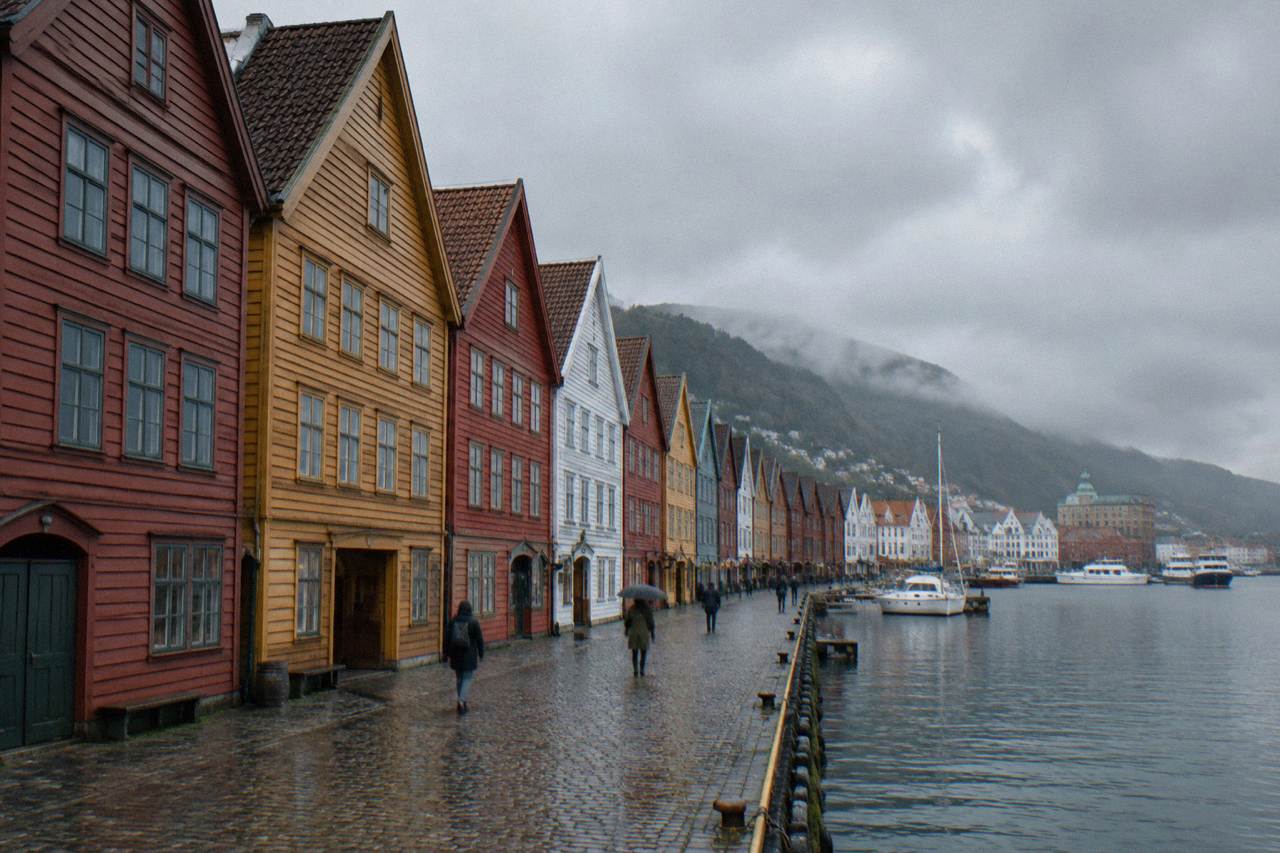
How Do Norwegians Say Bergen?
In standard East Norwegian, the city's name is pronounced roughly BARE-gen, two syllables with heavy stress on the first, a tapped or soft g in the middle, and a final syllable that is barely voiced. In the Bergen dialect itself, the pronunciation is closer to BARE-yen, where the middle g softens almost to a y sound. Neither version rhymes with the English word burden, and the stress never moves to the second syllable.
The key is the vowel in the first syllable. Norwegian does not have the er sound English speakers automatically produce when they see the letter e followed by an r. Instead, the e is a bright, open vowel, much like the a in the English word bad, and the r that follows is produced further back in the mouth, either tapped against the ridge behind the teeth or, in Bergen's coastal speech, softened to something closer to the French r. Say BAH-ren quickly, clipping the second syllable so it is almost swallowed, and you are close to what a Norwegian hears as correct.
The second syllable causes less trouble. It contains the letter pair e-n, but in fast Norwegian speech it reduces to a short, neutral sound, something like the unaccented syllable at the end of the English word sudden. The name is not BARE-gone. There is no drawn-out vowel, no emphasis, and no rising tone at the end. Norwegians say the name fast and low at the back, and the whole word occupies less than a second of speech.
One more habit worth copying: Norwegians almost never say the city's name in isolation when giving directions. Locals refer to downtown as sentrum or byen, the town, and the name Bergen itself shows up mostly when people talk about travelling to it or from somewhere else. A local answering the question of where something is will more often name a neighbourhood, Sandviken, Nordnes or Marken, than the city itself. That detail tells you a lot about how the dialect works: it is built for insiders, and it compresses everything.
Why Does The Bergen Dialect Sound So Different From Standard Norwegian?
The Bergen dialect is one of the most distinctive urban accents in Scandinavia because it collapsed a three-gender grammatical system into two, kept Old Norse words that the rest of the country dropped, and absorbed centuries of Low German from the Hanseatic League merchants who ran the Bryggen wharf. Standard Norwegian pronunciation was shaped in the east of the country, around Oslo, and Bergen's speech grew separately on the coast.
The historical reason is trade. From the late medieval period, German merchants of the Hanseatic League dominated Bergen's commerce and lived in their own quarter on the wharf. Their language left marks on the city's vocabulary that survive to this day, and the contact between Norwegian, German and the shipping world of the North Sea produced a way of speaking that Norwegians from elsewhere can identify within a sentence or two. UNESCO's own listing for Bryggen notes the wharf was inscribed on the World Heritage List in 1979, precisely because this trading culture shaped the city physically and, as a side effect, shaped how it sounds.
Grammatically, the standout feature is gender. Most Norwegian dialects keep masculine, feminine and neuter nouns, three grammatical genders. Bergen is famous for having largely folded the feminine into the masculine, so the city uses two genders where the rest of the country uses three. A traveller will not notice this from a phrasebook, but it is the single most-cited fact about the dialect among linguists, and it means phrases that look textbook-correct on paper can sound foreign in a Bergen mouth.
The accent also clips word endings harder than eastern Norwegian does. This is part of why the name of the city itself, said by a local, can land as something closer to a two-beat grunt than the three-syllable word the spelling suggests. There is no rule you can learn from a book that covers it; the sound is an inheritance from a port city that talked to sailors, not to grammarians.
For a visitor, none of this needs to be studied. It needs only to be noticed. When a local answers a question in a tone that sounds brisk, that is the dialect's cadence, not impatience, and when the same person switches to fluent, near-native English two sentences later, that is one of the most consistent features of travel in Norway. The contrast between how Bergen sounds and how easily its residents handle English is the thing that genuinely surprises people.
How Do You Pronounce The Landmark Names Around Bergen?
Fløyen is said roughly FLUR-yen with the stress on the first syllable, Bryggen is BRIG-gen with a hard g as in give, Ulriken is OOL-ree-ken with three beats, and Nærøyfjord starts with a sound English does not have: the æ, a vowel between the a in cat and the e in end. Every one of these names is pronounced with the stress at the front, which is the single most reliable rule for Norwegian place names.
This is where the fun starts, because the letters æ, ø and å are real letters in Norwegian, not typographical accidents, and each represents a vowel English speakers have to fake. The å is the easiest, a round sound close to the aw in law. The ø is the sound of French eu or the i in the English word bird said without the r. The æ, which opens the name Nærøyfjord, sits between cat and end. Practise those three and most of the signage in the city becomes sayable.
| Name you will see | Approximate English rendering | What trips people up |
|---|---|---|
| Bergen | BARE-gen | Stress stays on the first syllable, never the second |
| Bryggen | BRIG-gen | y is a tight ee sound, and both g's are hard |
| Fløyen | FLUR-yen | ø is the bird vowel, and the ending drops to almost nothing |
| Ulriken | OOL-ree-ken | Three syllables, with the final one clipped short |
| Fisketorget | FIS-keh-tor-get | Stress on the first syllable of each half of the compound |
| Nærøyfjord | Nair-uh-fyord | æ has no English equivalent, and the y is the tight ee |
| Bybanen | BOO-bah-nen | The city's light rail, literally the town line |
The pattern across the whole table is front-loading. Norwegian compounds, names built by gluing smaller words together, carry their stress on the first element, so a name that looks long and unwieldy in writing is actually spoken as a series of short, clipped beats with the weight at the start. Fisketorget, the fish market, is not a mouthful in a local's mouth; it is three quick taps.
The mountain names deserve a special note because they appear on every tourist map and half of every itinerary. Fløyen, the mountain the funicular climbs, keeps its Danish-era spelling, and the y in its name is the same tight vowel as in Bryggen. Ulriken, the taller of the city's two mountains, is the more forgiving of the pair for English speakers because its three syllables map neatly onto sounds English already has. Both mountains are covered in depth in the site's guide to Bergen's two summits and cable cars, which also compares the funicular against the Ulriken cable car for anyone deciding between them.
Speaking of which, the Ulriken643 cable car is confirmed live and priced for the 2026 season, and the operator's own prices page lists an adult return at 435 NOK. The tower's scheduled maintenance closure ran in the first two weeks of 2026 with a reopening around 13 January, so anyone planning a winter visit should still check the operator's site for the Christmas-period openings before heading up.
Do You Need Norwegian To Enjoy Bergen?
No, and in practice almost nobody travelling to Bergen uses any. English is taught from the first years of school across Norway, staff at museums, ticket desks, restaurants and transport hubs in the city work in English as a matter of course, and the language barrier visitors actually encounter is closer to zero than in most of Europe. Norwegian itself exists in two written standards, Bokmal and Nynorsk, which reinforces how much variation the spoken language carries.
That last point is worth pausing on, because it explains the city's confidence with languages. A country whose written language comes in two official standards, and whose television imports British and American shows in the original English with Norwegian subtitles rather than dubbing them, produces adults who have heard English daily since childhood. Norwegians will often apologise for their English and then speak it better than the visitor speaks anything. Do not let the apology mislead you.
This creates a small social wrinkle that is worth knowing before arrival. Because English is so widely and willingly spoken, launching into rehearsed Norwegian phrases can produce a gentle switch to English within a sentence, and the switch is friendliness, not rejection of the effort. The phrases that survive the switch are short ones: hei for hello, takk for thanks, and unnskyld for excuse me. A local will understand the rest of your sentence in English, so the useful strategy is to use the single word and let the rest go.
The language question also has a practical edge for anyone comparing Norway's two biggest cities for a first trip, since the Oslo side of the comparison is the one where standard Norwegian, the accent heard in national broadcasting, is the local norm. The fuller head-to-head lives in the site's comparison of Bergen against Oslo for visitors, but the short version for this page is that Bergen's dialect is the more distinctive of the two, and hearing it is part of what makes the city feel separate from the capital.
For the food-adjacent side of the city, hearing the dialect at a fish market counter is one thing, and being walked through it by a guide who narrates the city between tastings is another. The operator's listing for the guided food tour that ends with a ride up Fløyen covers exactly that ground: Check availability if that combination of accent, salt fish and mountain views appeals. The broader question of what the city is actually known for eating is answered in the companion piece on the food Bergen is famous for.
Where Does The Name Bergen Come From?
The name comes from old Norse words for mountain and meadow or pasture, roughly the farm in the hills, which fits a city squeezed between seven mountains and the sea. The spelling has been stable for centuries, but the pronunciation never stopped moving, which is why the letters and the sound have drifted apart the way they have, and why the English reading of the word is the odd one out rather than the local one.
That etymology is also the cleanest explanation of why the pronunciation carries so little of the written word's weight. A name that originally described a place between slopes was said quickly, daily, by people walking up and down those slopes, and the clipped two-beat version won out over any careful, syllable-honouring delivery. The same thing happened to Bryggen, which simply means the wharf, and to Marken, Nordnes and Sandviken, the inner neighbourhoods whose names appear on every hotel booking map.
The seven mountains framing the city are the other half of the name's context. Fløyen and Ulriken are the two visitors ride up, and the remaining five sit along the same ridge lines that gave the city both its sheltered harbour and its famously wet weather. The climate in this part of the coast is temperate oceanic, wetter than most of Norway, and the yr.no station table for Bergen shows just how wet: 217 days with precipitation across the trailing 13 months, with November 2025 alone recording 321.8mm of rain against a normal of 275.0mm. Any visit planning should treat rain as the default, which is covered from a packing angle in the site's piece on how many days in Bergen is enough.
Common Questions About Saying Bergen
How do Norwegians say Bergen?
Norwegians say it roughly BARE-gen, with stress on the first syllable and a clipped, almost swallowed second syllable. In the local Bergen dialect the middle consonant softens further, so the pronunciation sounds closer to BARE-yen. The name never rhymes with the English word burden.
Is the Bergen dialect hard for other Norwegians to understand?
Other Norwegians understand it easily, but they recognise it instantly. The dialect's two-gender grammar, its clipped endings and its Hanseatic-era vocabulary mark a speaker as being from Bergen within a sentence or two, even though mutual comprehension is complete.
How do you pronounce Fløyen?
Roughly FLUR-yen, with the stress at the front, an ø vowel like the i in the English word bird said without the r, and a final syllable that drops almost to nothing. It is the name of the mountain the funicular climbs and one of the two names most commonly garbled by visitors.
How do you pronounce Bryggen?
BRIG-gen, with both g's hard as in the English word give and a tight ee vowel in the first syllable. The name means the wharf, and it refers to the colourful Hanseatic wooden buildings on the harbour, a UNESCO World Heritage Site since 1979.
Will people in Bergen speak English to me?
Almost certainly, and unprompted. English is taught from early school years across Norway and subtitled rather than dubbed television means residents hear English daily. A single Norwegian word such as hei or takk will land well, but staff at museums, restaurants and transport hubs will switch to fluent English without being asked.
What do æ, ø and å sound like?
The å is close to the aw in law, the ø is like the French eu or the vowel in the English word bird without the r, and the æ sits between the a in cat and the e in end. Those three letters appear in names like Nærøyfjord and Fløyen, and they are the only sounds in the city's signage that English has no direct match for.
The pronunciation question is really a doorway question. Once the name of the city sounds right, the rest of the west coast follows, because the same rules, front stress, clipped endings, those three extra vowels, govern every fjord, village and mountain name from here to Ålesund. For a full planning pass around the city, including the seasons and the transport, the Bergen Travel Guide homepage collects the money-page essentials in one place, and the site's piece on what is so special about Bergen, Norway explains why the city between the seven mountains rewards the trip regardless of how its name comes out of your mouth.