Is Norway Friendly To American Tourists?
Bergen, in Vestland county on Norway's southwestern coast, is one of Europe's most welcoming cities for American visitors. What friendliness actually looks like here, and what to expect.
Bergen, a city and municipality in Vestland county on Norway's southwestern coast and a former Hanseatic League trading post, is regularly described by American visitors as friendly in a quiet, practical way rather than a gushing one. Norwegians here will not usually approach you first, but ask a question and you get a direct, helpful, nearly always English-fluent answer. This page breaks down what that means in real situations, from language and safety to money, budgeting and the social customs that catch Americans off guard.
Is Norway Friendly To American Tourists?
Yes, Norway is friendly to American tourists, and Bergen is a comfortable place to test that claim. English is spoken almost universally, crime affecting visitors is low, Norwegians are direct rather than effusive, and Americans are a familiar, unremarkable presence in a city that has traded with the outside world since the Hanseatic era. The friendliness is real, it just arrives as helpfulness rather than small talk.
The Norwegian social style is the single biggest thing Americans misread. In much of the United States, friendliness means initiating conversation, smiling at strangers and filling silence. In Norway, it means leaving people alone until they signal otherwise, then helping thoroughly once they do. Ask a Bergen local for directions and you will often get a full answer, a correction of your pronunciation and a follow-up question about where you are from. Do not expect the person to keep chatting afterwards; that is not coldness, that is the deal.
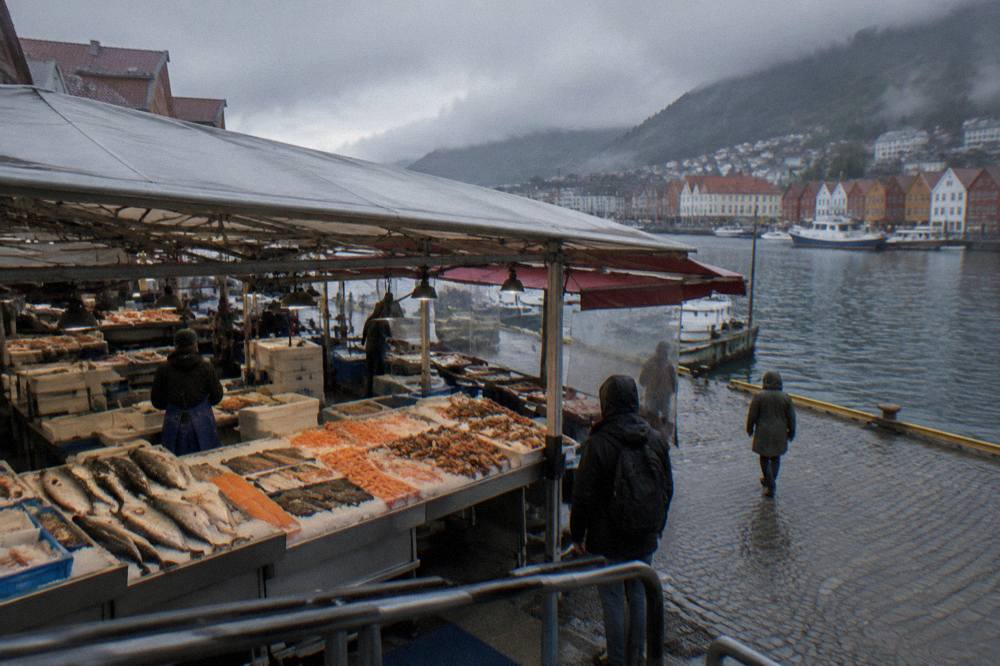
Bergen specifically softens the stereotype. The city's identity is built on trade, seafaring and centuries of contact with German, Scottish and Dutch merchants, and Bergensers carry a reputation inside Norway for being more talkative and weather-proofed than the average Norwegian. A fishmonger at the market, a guide on a walking tour or a fellow passenger on the Fløibanen funicular will typically open up quickly. Rain helps: when 217 days of precipitation fall in thirteen months, people share shelters, and conversation follows.
For Americans the practical upshot is that the friction points are almost never personal. They are price tags, quietness and the fact that nobody will rush to serve you in a shop the way a US sales associate might. None of that is about you. If you want a fuller comparison of how Bergen stacks up against the capital, read which is nicer, Oslo or Bergen.
How Are Americans Actually Treated In Bergen?
Americans are treated in Bergen as ordinary tourists, neither singled out for warmth nor for hostility. Norwegians hear American accents constantly during the summer cruise and fjord season, so you are a familiar category, and the political distance between the US and Norway rarely surfaces in a visitor interaction. What locals do notice is behaviour, not nationality: queue politely, greet before asking and thank after, and you will be received well.
The greeting rule matters more than Americans expect. In Norway you say "hei" or "unnskyld" before launching into a request, in a shop, at a counter, on a tour. Skipping that reads as rude regardless of accent. Once the greeting is in place, Norwegians switch to fluent English without any sigh or comment, and they switch comfortably mid-sentence if you struggle with a Norwegian word.
Tipping is another low-stakes area. Norway is not a tipping culture the way the United States is; service staff are paid properly and a tip is a small bonus for genuinely good service rather than an obligation. Rounding up a restaurant bill or leaving a modest percentage is appreciated, and nobody will chase you for more. Bergen Travel Guide has a full page on how many days in Bergen is enough if you are mapping the rest of a first visit.
One honest caveat: Norwegians are reserved with everyone, including each other. Friendships form slowly and are not performed in public. An American expecting the service-with-a-smile of a US mid-range hotel may read the flat, efficient front desk as unfriendliness. It is not. It is a different default setting, and on the street, in museums and on tours, the help you get is genuine and unhurried.
A guided introduction is the fastest workaround for the reserve, because a guide's job is to talk. Food walks in particular put Americans at a shared table with a local, which is the one setting where Norwegian quiet reliably dissolves.
Is Bergen Easy For First-Time American Visitors?
Bergen is compact, walkable and simple for first-time American visitors. The historic centre is small enough to cross on foot in well under an hour, the Bybanen light rail connects the airport to the city, signs are bilingual, and the main sights, Bryggen, the Fish Market, Fløibanen and the two mountains, cluster within a few blocks of each other. English-language support is universal in tourism settings.
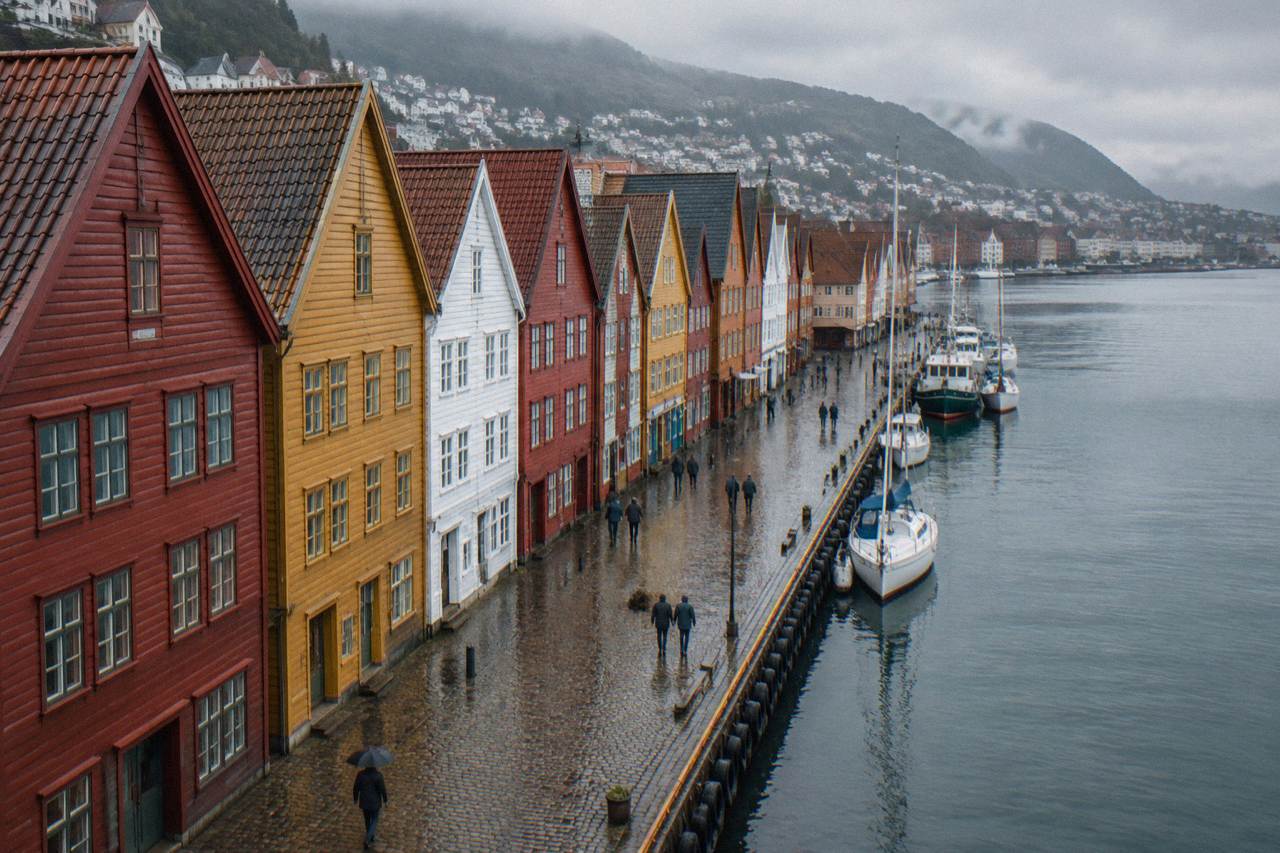
The city centre between the harbour and the park at Lille Lungegårdsvann is effectively a walking zone, and the wooden houses of Bryggen, a UNESCO World Heritage Site inscribed in 1979, sit within sight of the cruise terminals. Visitors arriving on a cruise day can cover a surprising amount on foot; see the guide to a cruise ship day in Bergen for the timing. For everyone else, the practical questions are the same ones Americans ask at home, just with different answers.
| American expectation | Bergen reality |
|---|---|
| Service staff greet you and offer help | Staff wait to be asked; greeting first is on you |
| Tipping 18-20 percent is standard | Tipping is optional and modest, a bonus not a wage |
| Card payments are universal | Card payments are near-universal, including contactless |
| Shop assistants chat while ringing up | Transactions are efficient and quiet |
| Strangers make small talk | Strangers help when asked, then go about their day |
Money is frictionless in a way that surprises Americans in the other direction. The currency is the Norwegian krone (NOK), not the euro, and cards, including phone wallets, are accepted essentially everywhere, down to food trucks. Cash is so rarely needed that many visitors never touch it. The detail worth planning for is not payment method but budget, because Norway is expensive and no friendliness discount applies. Dinner, a museum and a funicular ride add up fast, and a fjord day trip is a real line item. The page on how expensive Bergen is breaks the numbers down properly.
Weather is the other thing to take seriously. Bergen is temperate oceanic and wetter than most of Norway; Met Norway data via yr.no shows monthly averages running from -1.4C in January 2026 to 14.9C in July 2026, with 217 days of precipitation across the trailing thirteen months. An American who packs for a generic "Scandinavia" trip of cold and dry often gets a week of mild drizzle instead. Layers and a real rain shell beat a heavy parka.
Do You Need To Speak Norwegian In Bergen?
No, you do not need to speak any Norwegian in Bergen. English is taught from primary school onward and spoken at a near-native level by most people under about sixty, and tourism staff, transport signage and museum labels accommodate English throughout the city. Learning a few words, hei, takk, unnskyld, earns a warm response, but no American visitor gets stuck on language.
Norwegians will often answer English with English even if you attempt Norwegian, simply because it is faster and they want to help. That can frustrate a keen learner, but read it as efficiency, not rejection. Menus, transit apps, ticket machines and trail markers are all available in English, and tour operators run everything from walking tours to fjord cruises in English as a default, not a courtesy. The wider set of guides lives on Bergen Travel Guide.
A few phrases do land well, mostly because they show you understand the greeting-first culture described above. Say "hei" entering a small shop, "takk" receiving anything, "ha det" leaving. Bergensers also love when visitors know the city's running joke about its own weather, and a comment about rain is a more reliable icebreaker than any question about the fjords.
What Surprises Americans Most About Bergen?
Three things surprise American visitors most in Bergen: the quiet, the price of alcohol and the closeness of the fjords. Norwegians keep public space calm and voices low, beer costs far more than in the United States, and the dramatic fjord landscape that Americans drive hours to reach in other countries begins within sight of the city's own harbour, with regular day trips running to Mostraumen, Hardangerfjord and Nærøyfjord.
The quiet extends to restaurants, where the ambient volume is typically a fraction of an equivalent US room. Americans sometimes interpret the lack of table check-ins as neglect; Norwegian service assumes you will flag someone when you want something. Waving is fine. Nobody is offended, and nobody thinks you are rude.
Alcohol is the budget item that needs saying twice. State alcohol taxes push bar and restaurant prices to levels that shock even New York and San Francisco visitors, and beer above a low strength is only sold through the state monopoly's shops, which close early on Saturdays and stay shut on Sundays. Grocery beer is weaker and cheaper but still not cheap. The page on a pint of beer in Bergen covers the specifics.
The fjord proximity is the happy surprise. From downtown Bergen, half-day and full-day trips reach narrow fjord arms, glacier lakes and the Flåm railway without an overnight, and the question of whether that is realistic is answered at length in can you do a day trip to the fjords from Bergen. Many Americans plan a fjord week and discover the fjord part can start the morning after arrival.
For travellers who want a single big day, a guided trip into the Nærøyfjord with a cruise section and the Flåm railway compresses the famous scenery into one itinerary, with the operator's live listing carrying current price and availability.
Is Bergen Safe For American Tourists?
Bergen is safe for American tourists by any reasonable standard, with low violent crime, a compact, well-lit centre and emergency services reachable through Norway's standard public emergency numbers. The risks worth actually planning for are weather on mountain trails, slippery wooden wharfs in the rain and the ordinary pickpocketing that comes with cruise crowds, none of which are directed at Americans in particular.
The mountains that frame the city deserve respect. Trails up Fløyen and Ulriken are accessible right from the centre, and Americans used to hiking with cell signal everywhere should know that weather can turn a summer ridge walk into something colder within an hour. Check yr.no, tell someone your route, and take the light seriously. The mountains are the closest thing to a genuine hazard in a city that is otherwise one of the safest a visitor can pick.
Day-to-day safety feels almost unremarkable, which is the point. People leave prams outside cafés, walk home through the centre late without tension and let children roam the harbour squares. The usual big-city habits around bags and phones cover everything else, and the question of whether Bergen is worth visiting at all, safety and otherwise, is answered at is Bergen worth visiting.
Entry formalities are the last box. Norway is a Schengen Associate, an EEA/EFTA member applying the Schengen acquis, but not an EU member, so US visitors enter under Schengen rules rather than EU ones. Do not rely on any published start date for the planned ETIAS travel authorisation; the launch has slipped repeatedly, and the official sources are the only place to check before you fly.
Common Questions About American Tourists In Bergen
Is Norway friendly to american tourists?
Yes. Norwegians, and Bergensers in particular, are helpful and direct toward American visitors, and English is spoken almost everywhere in the city. The friendliness shows up as reliable assistance rather than outgoing small talk, so the experience feels calm rather than cold.
Do Norwegians like Americans?
Norwegians generally treat Americans as ordinary visitors, and the shared history, strong trade ties and widespread English make the relationship easy. Political disagreements may come up in conversation with people you get to know, but they almost never affect how a tourist is served or welcomed.
Should I tip in Bergen as an American?
Tipping is optional in Norway because service staff are paid properly. Rounding up a restaurant bill or leaving a small amount for genuinely good service is appreciated, but no one expects an American-style percentage, and no one will think less of you for leaving nothing extra.
Can I use my US credit card in Bergen?
Yes. Cards are accepted essentially everywhere in Bergen, including contactless and phone payments, and cash is rarely needed at all. US cards without a foreign transaction fee work fine; the currency is the Norwegian krone, not the euro.
Is Bergen safe to walk around at night?
Bergen's centre is considered safe to walk at night by normal big-city standards, with well-lit streets and low violent crime. Ordinary care around bags and phones in the busiest tourist areas is enough, and the harbour and main squares stay calm late into the evening.
How many days do I need in Bergen?
Most American visitors find two to three days enough for the city itself, with the harbour, Bryggen, Fløyen and the museums coverable in that window, plus a separate day for a fjord trip if the schedule allows.
The short version: pack for rain, greet before you ask, budget honestly, and the same city that seems quiet at first glance will keep answering your questions in perfect English until the fjords run out.